Rack position matters
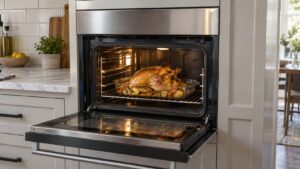
The correct rack position in your Thermador wall oven can mean the difference between a perfectly golden crust and a burnt bottom. Thermador ovens have 5-7 rack positions (depending on model), and each serves a purpose. The True Convection system provides even heat, but rack position still affects how food cooks — especially for browning, rising, and broiling.
Position 1-2 (bottom)
Best for: pizza, bread, pies, and anything that needs a crispy bottom. The bottom element provides direct radiant heat from below. In convection mode, position 2 gives slightly more even results than position 1 because the convection airflow is less disrupted.
Position 3 (center)
The default for most cooking: cookies, cakes, casseroles, roasted vegetables. Center rack provides the most even heat distribution, especially in True Convection mode where the ring element and fan create uniform temperature throughout the cavity.
Position 4-5 (upper)
Best for: broiling, gratins, and finishing with a golden top. Position 5 (closest to the broil element) is for direct broiling — watch closely, food can go from golden to burned in seconds at this height. Position 4 gives gentler top browning for casseroles and gratins.
Multi-rack convection cooking
True Convection excels at multi-rack cooking — you can bake on positions 2, 3, and 4 simultaneously with even results. Don’t use flat baking sheets that block airflow between racks — use pans with low sides or wire cooling racks on baking sheets for best air circulation.
Double and triple oven strategy
In a double wall oven, use the upper oven for broiling and high-heat roasting, lower oven for baking and gentle cooking. In a triple, dedicate the top to high-heat tasks, middle to everyday baking, and bottom to low-temp holding or slow roasting.
Need professional Thermador Oven service?
If troubleshooting doesn’t resolve the issue, our certified Thermador technicians can help. We service all Thermador Oven models across all 50 states with genuine OEM parts and a 30-day labor warranty. Schedule service online — same-day booking available.
Related Thermador resources
- Thermador Oven repair service — certified technicians in all 50 states
- Thermador error code database — search all Oven error codes
- Thermador model database — specifications and repair info by model number
- Thermador official site — official specifications, manuals, and product information
Important notes for Thermador oven owners
- Always use genuine OEM parts — aftermarket components may fit but can compromise performance, safety, and warranty coverage on Thermador appliances
- Never ignore error codes — Thermador codes are diagnostic aids designed to prevent small issues from becoming major failures. Address them promptly
- Keep your owners manual accessible — it contains model-specific maintenance schedules and troubleshooting trees. Digital versions are available on the Thermador official site
- Document issues before calling — note error codes, symptoms, when they started, and patterns. This helps the technician diagnose faster
- Use surge protectors — power fluctuations damage electronic control boards. A quality surge protector protects your investment
When DIY troubleshooting is not enough
Some Thermador oven issues can be resolved with the steps in this guide. However, call a certified technician immediately if you encounter:
- Gas smell (gas models) — turn off the appliance, open windows, leave the house, call from outside
- Burning smell or smoke — disconnect power immediately. Do not use until inspected
- Electrical sparking — turn off at the circuit breaker. Wiring or component failure
- Water leaking inside walls — shut off supply and call to prevent water damage
- Error codes that return after power reset — persistent codes indicate real component failure
- Sealed system issues — compressor, refrigerant work requires EPA-certified technicians
Schedule service online — our certified Thermador technicians carry genuine OEM parts and serve all 50 states with a 30-day labor warranty.