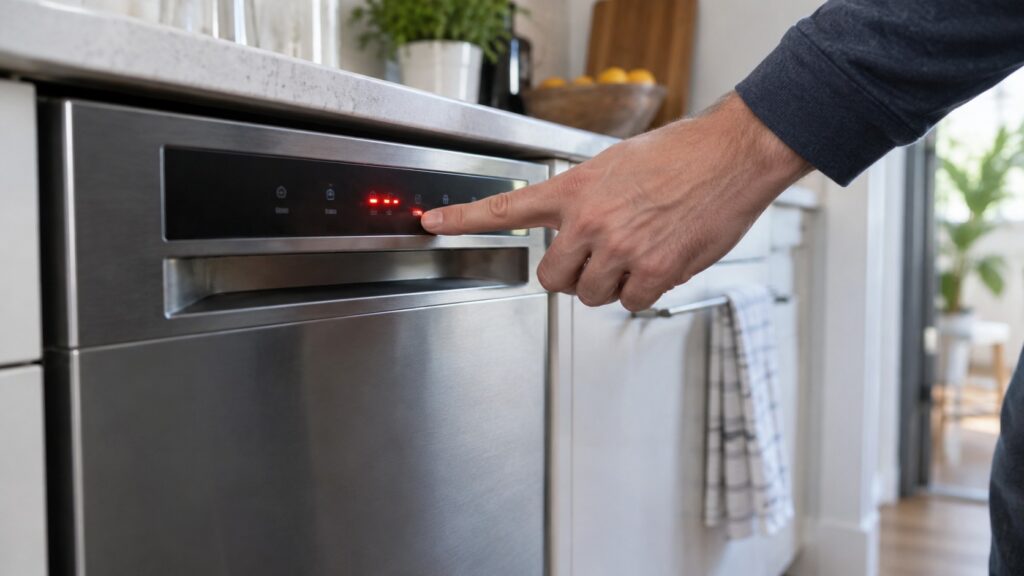
A Thermador dishwasher E19 code is not the same problem as E20 or E21, even though the three numbers sit next to each other on the display list. Thermador dishwasher E19 means the diverter valve has failed and can no longer steer water correctly between the spray arms and levels — a water-distribution fault. E20 is a different subsystem entirely: the wash motor has tripped its thermal protection from overheating. E21 is a third subsystem again: the drain pump has pulled excessive current, usually because something is straining the motor or the pump is on its way out. Adjacent numbers, three unrelated parts.
What does Thermador dishwasher E19 mean?
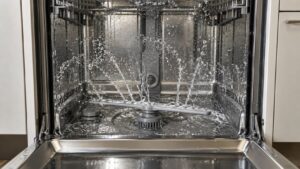
Thermador dishwasher E19 points at the diverter valve, the small motorized part that switches water flow between the upper and lower spray arms during a cycle. When it fails, the control board can no longer confirm the valve moved where it commanded, so it stops the cycle and raises E19 rather than run the wash with water going to the wrong level. You may notice one rack getting a strong spray and the other almost nothing, or a cycle that stalls partway through with the tub full of water and no motion.
The valve itself is a small motor and a set of internal seals rather than anything you can lubricate or reset from outside the machine. A power cycle is worth trying first, since it clears a latched fault rather than a live one, but a diverter valve that has actually failed will raise the code again as soon as the wash cycle reaches the point where it needs to switch levels.
What does Thermador dishwasher E20 mean?
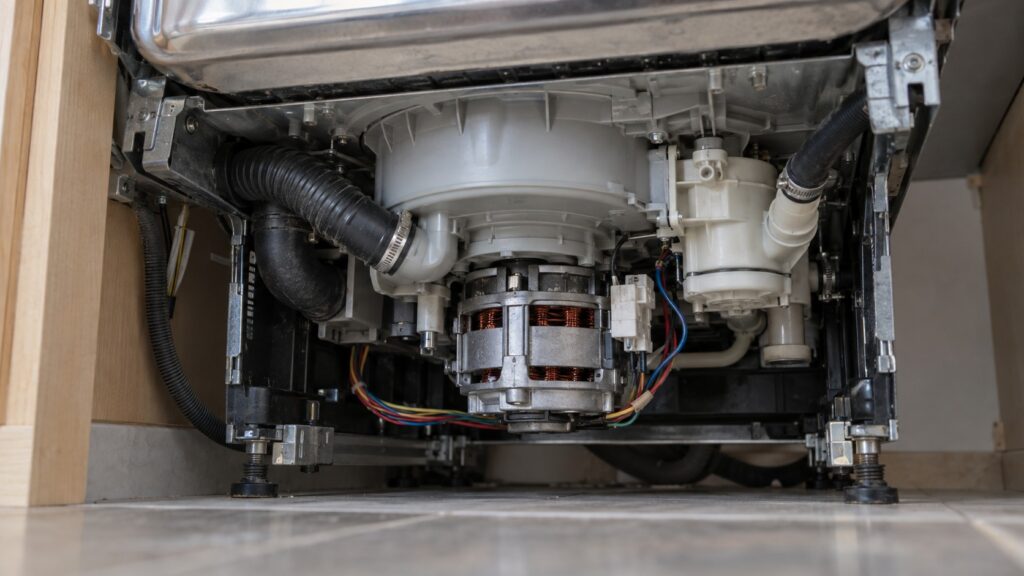
E20 is the wash motor telling the control board it got too hot and shut itself down to protect its windings. That can happen because the motor itself is failing, but it can also happen for reasons that have nothing to do with the motor: a bearing dragging inside the pump housing, a blocked filter making the motor work harder than it should for a normal cycle, or a ventilation problem inside the base of the unit that traps heat around the motor housing. The motor is the part that reports the fault, but it is not always the part that caused it.
Before assuming the motor is bad, pull and rinse the lower filter assembly and check that nothing is lodged against the wash impeller at the bottom of the tub. A dishwasher that has been running with a partly clogged filter puts steady extra load on the motor, and E20 after months of slightly longer cycles is a common pattern.
What does Thermador dishwasher E21 mean?
E21 is the drain pump reporting an overload — it is pulling more current than the control board expects for a normal drain. The most common cause is mechanical: something has worked its way into the pump chamber, a broken piece of glass, a bottle cap, a shard of plastic, and the impeller is fighting it rather than spinning freely. The second most common cause is a pump bearing that has started to fail, which raises current draw even with a clear chamber. Either way, the pump motor is under load it was not designed to run against continuously.
Standing water in the tub after a cycle, combined with an E21 code, is worth checking with the power off before anything else: lift the lower filter, look into the sump for debris, and turn the pump impeller by hand if you can reach it. If it turns freely and the water still will not clear, the pump itself is the likely part.
Why do these three codes sit next to each other but mean different things?
Thermador’s numbering groups its dishwasher fault codes loosely by the stage of the cycle where the control board detects the problem, not by which part is responsible. E19, E20 and E21 all surface during active wash and drain operation, which is why they cluster together numerically, but E19 belongs to the water-distribution system, E20 to the motor’s own thermal protection, and E21 to the drain circuit. Treating them as a family because the numbers are close is the mistake that sends people chasing the wrong part.
The safest habit is to read the exact code on the display rather than assume it is close enough to one you have seen before. A single digit is the entire difference between a diverter valve repair and a drain pump repair, and the parts involved, and the labor, are not interchangeable.
What can you safely check before calling for service?
All three of these faults tolerate a short list of owner checks: cutting power for a couple of minutes to clear a latched code, pulling and rinsing the lower filter assembly, and looking into the sump area for anything visible that does not belong there. If the code returns immediately after a clean power cycle and a clear filter, the part behind the code is genuinely at fault rather than reacting to debris.
Stop before opening the pump housing, the motor assembly, or anything behind the lower access panel. Those components sit close to the water circuit and to line voltage, and a Thermador dishwasher chassis is not designed for that kind of access without training and the right seals on reassembly.
When does an E19, E20 or E21 code need a technician?
Any of these three codes that returns after a filter clean and a power cycle is describing a part problem rather than debris, and that is the point to book service. A diverter valve, a wash motor and a drain pump are each a distinct repair with its own parts and labor time, which is exactly why identifying the right code matters before a part gets ordered.
We are an independent repair company, not a factory service arm, and we will tell you honestly when a repair is not worth doing on an older unit. Pricing starts from a diagnostic visit and we confirm the estimate before any work begins. Our Thermador dishwasher error codes guide covers the full list beyond this trio, and Thermador dishwasher troubleshooting walks through the checks above in more detail. Thermador dishwasher repair covers the diverter valve, wash motor and drain pump, and you can schedule a visit with the exact code on hand.