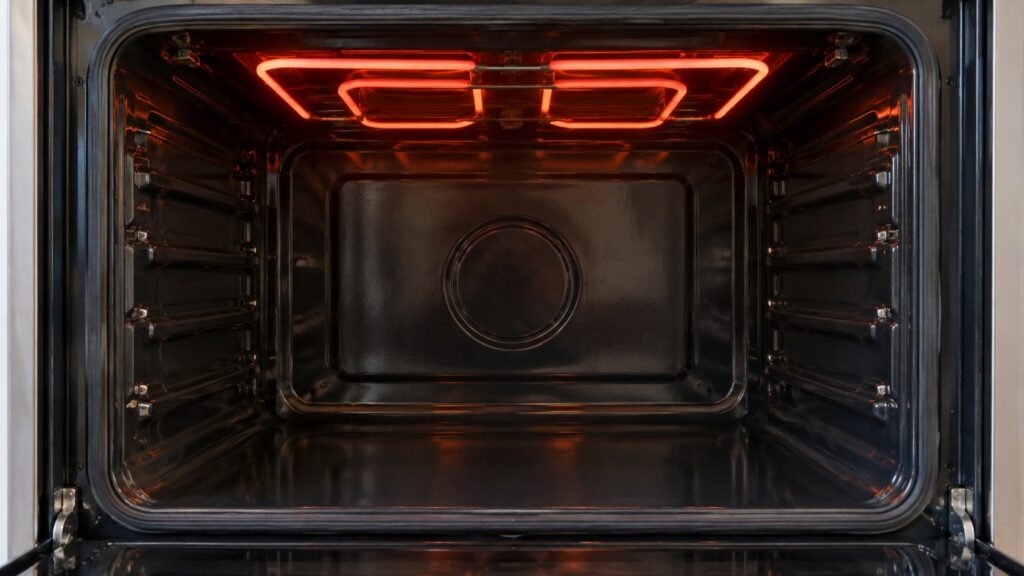
The Thermador oven bake broil elements are a pair that does two different jobs. The bake element heats the cavity so the air and the walls reach the temperature you set, and the broil element sits at the top and gives off intense heat straight down onto the food. A temperature sensor tells the control board when to switch the elements on and off, so the oven holds a steady temperature instead of just getting hotter. On a True Convection model a ring element and a fan are added to move that heat around.
What does the bake element do in a Thermador oven?
The bake element is the main source of heat when you choose a normal bake setting. It warms the air in the cavity, and the air and the walls then warm the food. You will notice that the element does not stay on the whole time. Once the oven reaches the set temperature, the control switches the element off and back on to hold it there, which is why you may see the glow fade and return during a long bake.
Where the element sits depends on the model, and some ovens hide it. Our pages do not describe the layout of every Thermador oven cavity, so check your owner’s manual for how yours is built and which parts you may touch when it is cool. Do not assume that what you see on the floor of the cavity is all there is.
What does the broil element do?
The broil element is at the top of the cavity. It gives off radiant heat, which means the heat travels straight down as infrared energy to the surface of the food. That is why broiling browns and chars quickly, and why the food has to sit on a rack at the height your manual suggests and be watched. Broiling is for the surface of a dish: melted cheese, browned tops, thin cuts of meat.
A broil element is not the right tool for slow cooking. Because the heat comes from one side, one face of the food cooks far faster than the other. If you want to cook through and brown at the end, bake first and broil for the finish.
How does the oven know when to switch the elements?
A temperature sensor in the cavity reports to the control board. Our oven glossary describes an NTC thermistor, a sensor that measures the cavity temperature. The board compares that reading with the temperature you set and switches the elements on or off to match. If the reading is wrong, the oven will run hotter or cooler than the display shows.
That is why the sensor matters as much as the elements. A weak element gives low heat even when the sensor is correct, and a faulty sensor gives wrong readings even when the elements are fine. Our guide to a Thermador wall oven that is not heating gives safe checks that help narrow it down without opening anything.
How does True Convection change the picture?
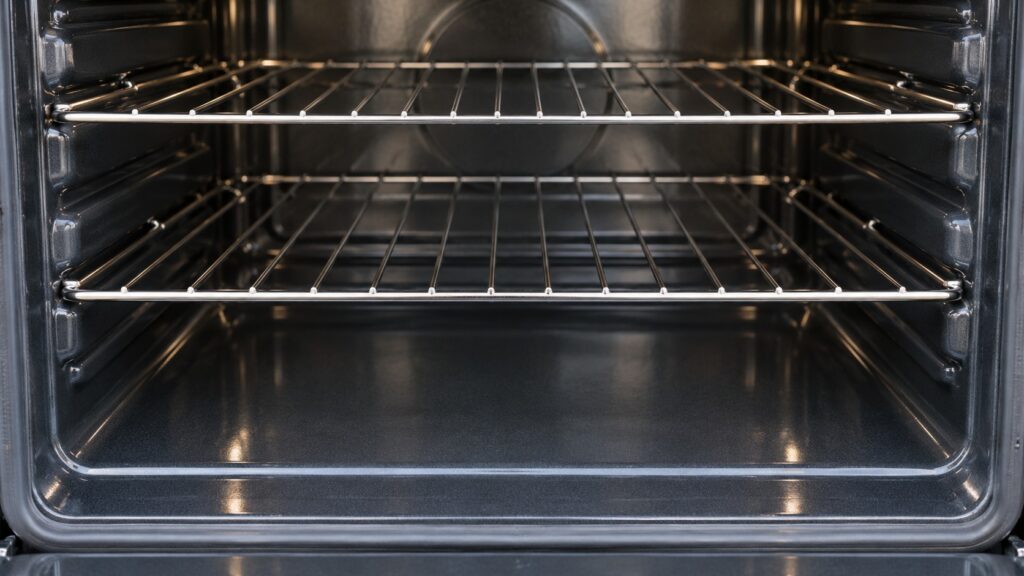
A True Convection oven has a dedicated third element, a ring-shaped one behind the fan, and the fan pulls air across it and circulates it through the cavity. Our explainer on how Thermador True Convection works covers the idea: the heat is moved around the cavity rather than coming only from the top and bottom. The bake and broil elements are still there, and the oven chooses the combination for the mode you select.
Which elements run in each mode on your oven, and how the modes are named, is in the owner’s manual. Our pages do not list the element combinations for each mode, so we will not guess at them.
How do you recognize an element fault?
The signs are fairly plain. An oven that heats slowly, takes much longer than before to preheat, cooks unevenly or never reaches the set temperature may have a weak element. Our oven code pages describe E207 as a bake element partial failure with reduced output, E206 as a broil element partial failure with reduced output and E014 as a convection element open circuit, a ring heater failure. Those are descriptions from our code pages, and your display and manual are the final word on what a code on your oven means.
You can do a safe visual check when the oven is cold and off. Look at the elements you can see: a visible blister, break or burned spot on an element is a sign it needs replacing. Do not touch the element terminals, do not run a damaged element and do not test anything with a meter. Elements carry high current, and a damaged one can arc.
What should you do if you smell burning or see sparks?
Turn the oven off. If you see sparks, a flame or smell burning that does not stop, switch off the breaker for the oven at the panel while standing on a dry floor, and keep the oven door closed so a fire cannot get air. Do not use water. Leave the oven off until a technician has looked at it. A cleaned cavity helps too: grease and food on the cavity floor smoke and can be mistaken for an element problem, as our oven maintenance guide explains.
When is it a job for a technician?
Any time the fix means removing a panel, a rear cover or the oven from its cabinet, or touching the wiring. A technician can test the elements and the sensor, tell which one is at fault and replace it. We are an independent repair company, not the manufacturer. Our Thermador oven repair page explains how a visit works, and you can book a visit online.