
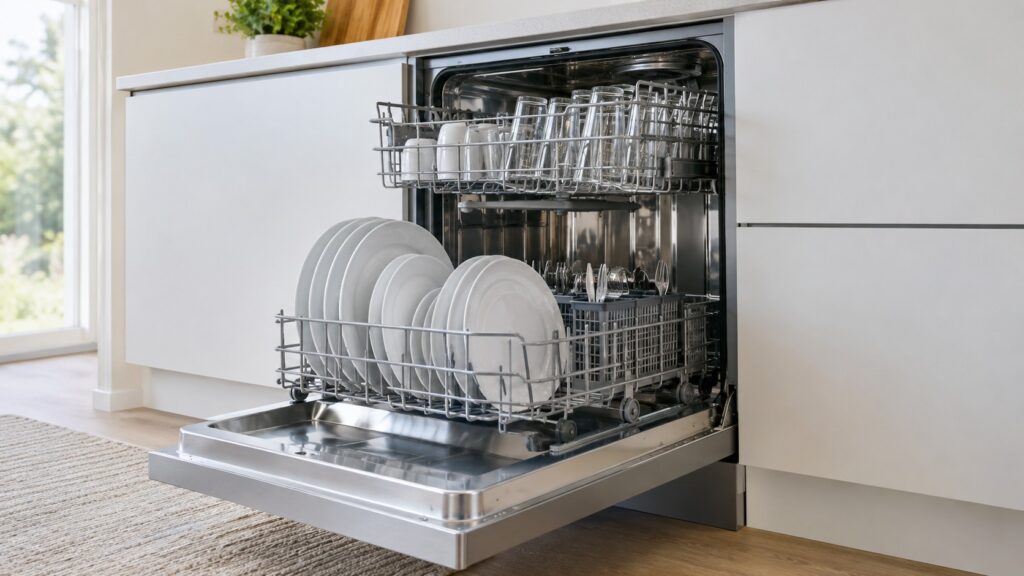
The simplest Thermador dishwasher detergent rinse aid advice is this: use dishwasher detergent made for machines, never liquid dish soap, fill the rinse aid dispenser as your owner’s manual shows, and change one thing at a time when dishes come out spotted or cloudy. Our dishwasher maintenance guide says to use quality dishwasher detergent tablets and never liquid dish soap, which makes too many suds and can damage the pump. Spots, film and cloudy glasses are usually a detergent, rinse aid or water problem, not a machine fault.
What detergent should you use in a Thermador dishwasher?
Use a detergent made for dishwashers, and follow the instructions on the package and in your owner’s manual. Our dishwasher maintenance guide specifically names detergent tablets and says never to use liquid dish soap. Dish soap is made to foam by hand, and a dishwasher with foam in it can spill suds out of the door and strain the pump.
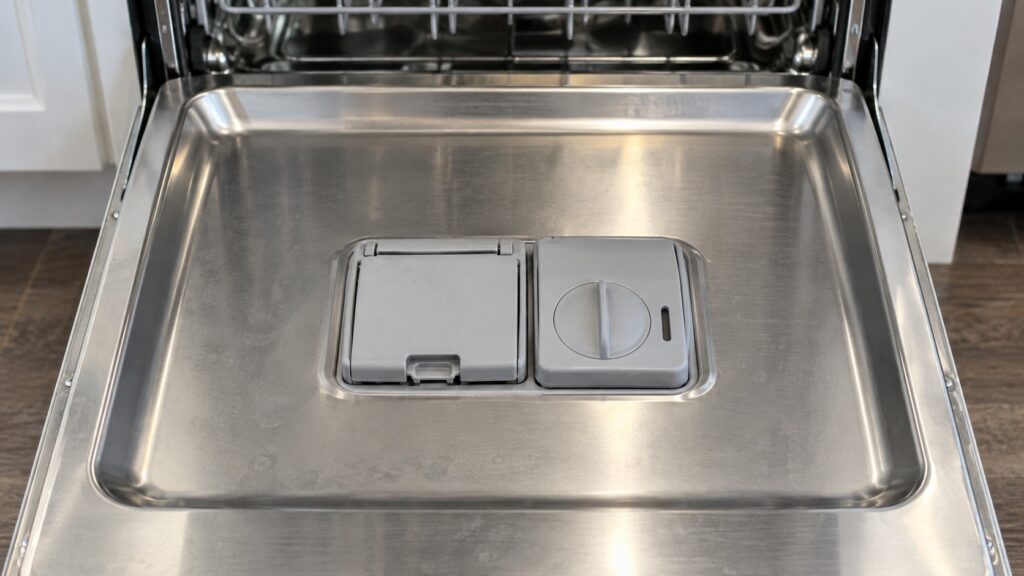
Put the detergent in the place designed for it. Most dishwashers have a closed compartment that opens at the right moment in the cycle, and putting it in the wrong place can leave residue or stop it dissolving properly. Where each one goes on your model is in the manual. Do not mix different detergents, and do not add extra detergent to a load that looks dirty. More detergent does not clean better, and it can leave a film.
Keep the box dry and closed. A tablet that has absorbed moisture clumps and can fail to dissolve.
What does rinse aid do?
Rinse aid is a liquid that helps water run off dishes in sheets, so they dry with fewer drops and spots. It is added from a separate dispenser, which our maintenance checklist tells you to check on a regular basis. Our model pages list dishwashers with condensation drying, such as the DWHD550WFP Sapphire, and with CrystalDry, such as the DWHD650WFP Emerald. How each drying system works with rinse aid is in your manual, and our CrystalDry explainer covers that system.
Fill the dispenser to the level your manual shows and wipe up any spill, because rinse aid that runs over the dispenser can foam in the next cycle. If the dispenser has an adjustment, your manual explains when to change it. Do not guess at the setting; turn it only if the manual says how.
Why are dishes cloudy or spotted?
Read the symptom. White spots and a chalky film often mean hard water, and a cloudy glass that does not rinse clean can mean the glass has been etched, which is damage that no detergent can reverse. Greasy streaks or detergent left in the dispenser can mean the dispenser did not open or the load blocked it. Wet plastic and spots can mean rinse aid is low or the load was arranged so water stayed on the dishes.
Change one thing at a time. First check that the rinse aid level is where it should be. Then check you are using dishwasher detergent in the amount the manual says. Then look at the load: bowls and cups tilted so they hold water, items that block the spray arms and dishes nested together all leave a wet surface and spots. Our Thermador dishwasher loading tips cover how to load for a clean result.
Does hard water change the advice?
It can. Hard water leaves mineral spots and film that detergent alone does not always remove, and some dishwashers have a built-in way to deal with it. Our dishwasher code pages describe E18 as a water softener regeneration problem, which tells us that at least some Thermador dishwashers have a softener, but we do not know which models, so check your manual before you rely on one. If you have hard water, the manual explains how to adjust the machine for it.
A regular cleaning cycle helps too. Our maintenance guide suggests running a hot empty cycle with dishwasher cleaner to clear mineral build-up, and cleaning the drain filter. Scale on the spray arms, the door seal and the filter makes every other problem worse. Our dishwasher not draining guide explains why a blocked filter shows up as dirty water and residue on dishes.
What if the detergent does not dissolve or the dispenser stays shut?
Look at the dispenser lid and the area around it for dried detergent or a bent latch, and make sure no tall item or handle is blocking the door of the compartment. If a tablet is left whole in the dispenser after a cycle, the water may not be reaching it, or the spray arm may be blocked. Take out the filter and look for debris, and check the spray arm turns freely by hand with the power off.
Do not take the door apart or reach into the dispenser mechanism. If the dispenser still does not open, or if you see water leaking from the door, stop and call a technician. If water reaches an outlet or the cord, switch off the breaker at the panel while standing on a dry floor, and do not pull the plug from a wet outlet.
When should you call a technician?
Call if detergent keeps being left in the dispenser after you have checked the load and the spray arms, if suds come out of the door, if the dishwasher leaks, or if a code stays on the display. We are an independent repair company, not the manufacturer. Our Thermador dishwasher repair page explains how a visit works, and you can book a visit online.