A Thermador dishwasher heating element or heater is the part that warms the water, and on some designs the drying. When it fails, the signs can be dishes that come out greasy or cloudy, wet dishes at the end of the cycle and sometimes an error code. Our dishwasher repair or replace guide lists the flow-through heater among the parts that are usually repaired, and says to consider replacing the dishwasher only when it is old and faces a major repair or several failures at once.
What does the heater do in a Thermador dishwasher?
Dishwashers clean best with hot water, which helps dissolve grease and helps detergent work. The heater brings the water up to the temperature the cycle needs. Our dishwasher maintenance guide and code pages refer to a flow-through heater, and our E09 page describes a flow-through heater failure and our E12 page describes limescale build-up that reduces heater efficiency. Exactly what your model uses and where it sits is for the owner’s manual, and our pages do not describe it further.
Drying is a different matter. Our CrystalDry explainer says CrystalDry models use a zeolite cassette to absorb moisture and make heat, so they dry without a heated dry element, while Sapphire models use condensation drying. So a dishwasher that leaves dishes wet is not necessarily a heater fault, and which drying system you have changes where you look.
How do you tell a heating problem from other problems?
Rule out the cheap causes. Dishes that come out wet, especially plastic, can mean the rinse aid has run out, the load is blocking the airflow or the drying system is a condensation type that leaves plastics damp. Greasy or cloudy dishes can mean too little detergent, the wrong detergent or a clogged spray arm or filter. See our guide to Thermador dishwasher maintenance and the CrystalDry explainer.
A heating fault shows up as a pattern: dishes come out greasy or cloudy every time even with the right detergent and a clean filter, or a code appears. Our code pages describe E09 as a heating element failure of the flow-through heater and E12 as limescale build-up that reduces heater efficiency, and they also list errors for the drain pump, the wash motor and the diverter valve. If your dishwasher shows a code, write it down exactly and look it up in our Thermador dishwasher error codes guide, because the code may point to something other than the heater.
When is repairing the heater the sensible choice?
When the rest of the dishwasher is sound. Our repair or replace guide lists the flow-through heater under the parts that are usually repaired. Consider the whole picture: Is the tub clean and free of rust? Do the door latch, the pump and the spray arms work? Is the panel-ready front in good shape? If the answers are yes, a working heater restores a machine that is otherwise fine.
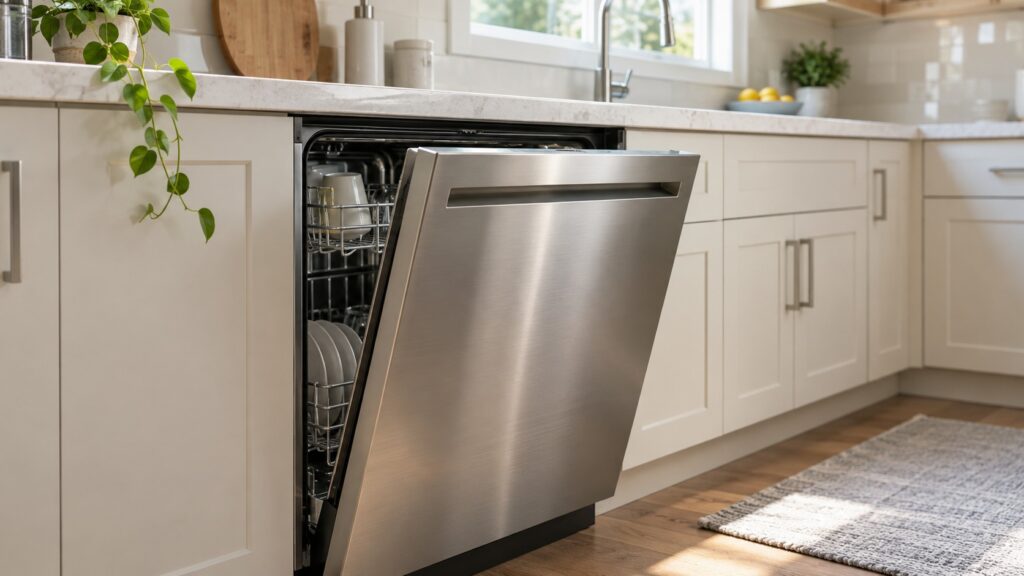
Panel-ready dishwashers add a factor. Our guide notes that a custom cabinet panel may not fit a new model if the dimensions or mounting points change, and that panel and bracket modifications add significant cost to a replacement, which often tips the scale toward repair. Our model pages list panel-ready dishwashers across the Sapphire, Emerald and Professional collections, so this applies to many Thermador owners.
When does replacing the dishwasher make more sense?
Consider replacing when the dishwasher is old and also faces other major repairs, such as a control board and a pump at the same time, or several failures that arrive close together. Each repair in isolation is reasonable, but a stack of them on an old machine is the signal. Replace it as well if it no longer cleans well for reasons that are not a single part, or if you want a feature a newer model offers, such as CrystalDry drying or a third rack.
If you replace it, check that the new model fits the opening and the panel. Our dishwasher buying guide helps you choose, and our dishwasher repair or replace guide gives the general framework. We do not quote prices here. Our repair or replace guide treats an old unit with a major repair, or several failures at once, as the point to consider replacing, so weigh the quote against the age and condition of the machine.
What should you do while it is not heating?
Do not keep running cycles that leave the dishes dirty, because dirty water and food can build up in the tub. Wash a load by hand, or run an empty cycle with dishwasher cleaner once, as our maintenance guide suggests for descaling. Do not open the base or touch the heater. A heater is a high-power part wired to household power and sits next to water, and checking it is a job for a technician. Do not test it with a meter.
If you see water leaking, smell burning or notice the door is hot, stop the cycle and switch off the breaker for the dishwasher at the panel while standing on a dry floor, and do not pull the plug out of a wet outlet. We are an independent repair company, not the manufacturer, and our Thermador dishwasher repair page explains how a visit works. You can also book a visit online.