
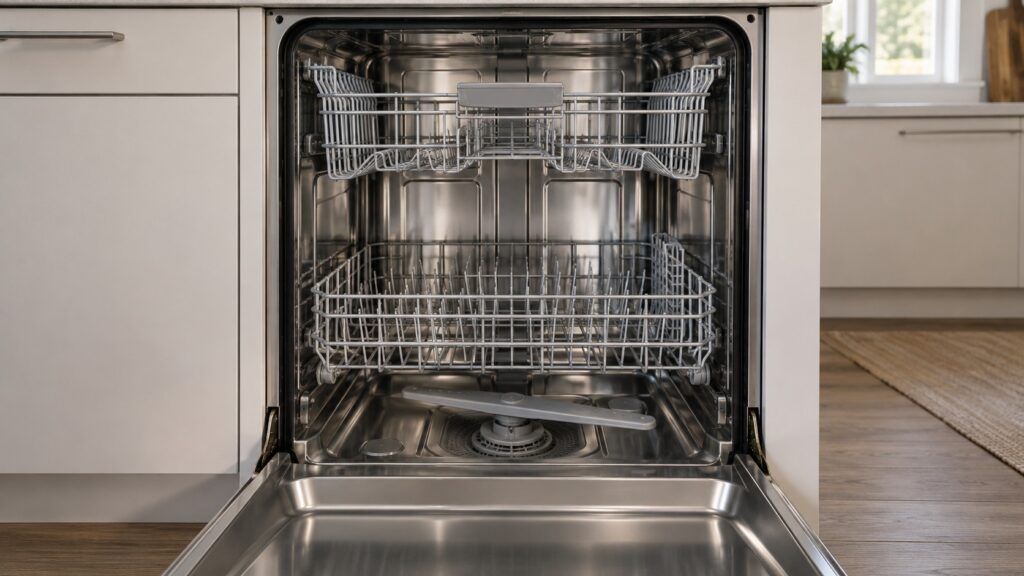
Cleaning a Thermador dishwasher spray arm is mostly a matter of looking for blocked holes and checking that the arm turns freely. Food bits, seeds, label scraps and mineral scale can plug the small holes that throw water, and the dishes then come out with food stuck on them or with a white film. Our dishwasher maintenance guide tells you to inspect the spray arm holes for clogs and to clear blocked holes with a toothpick. The arm comes out only as your owner’s manual shows, and the rest of the cleaning is the drain filter.
What does the spray arm do in a Thermador dishwasher?
A spray arm is a rotating arm with a row of holes. Water is pumped into it, and the pressure of the water leaving the holes pushes it round, so the jets sweep the whole rack. Dishwashers have one at the bottom of the tub and, on many models, another above the upper rack, and some have an arm for a third rack. Our model pages list Thermador dishwashers across several collections, including the Professional DWHD870WFP with a third rack and the Emerald DWHD650WFP with the adjustable FlexRack third rack.
How many arms your dishwasher has, where they sit and how they come off differ by model, so check your owner’s manual. If an arm cannot spin or its holes are blocked, the dishes in front of it get little or no water, and the wash falls short even though the machine runs normally.
How do you tell if a spray arm is clogged?
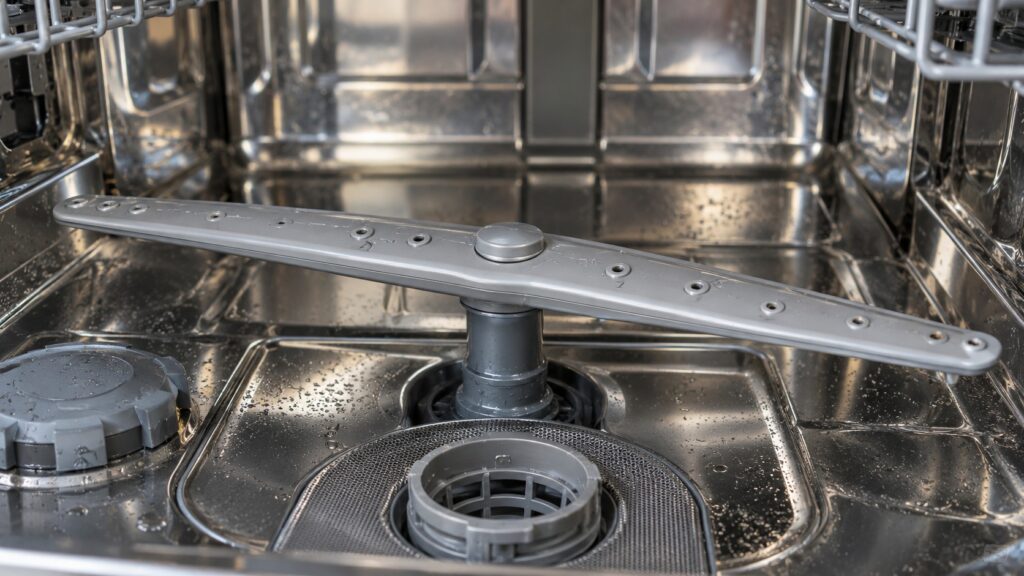
Look at where the dishes are dirty. If the same area comes out dirty every time, the arm that serves it may be blocked. Look at the holes: a hole filled with a bit of food, a seed or mineral scale is easy to see. Then, with the dishwasher off and the racks out of the way, turn each arm by hand. It should turn freely and without catching. An arm that scrapes, sticks or wobbles may be blocked by a dish or a utensil that has fallen through the rack, or its bearing may be dirty.
Also notice any change in noise. A rattling or knocking from the tub can mean an arm is hitting something. Our Thermador dishwasher noise guide explains what the different sounds point to.
How do you clean a spray arm safely?
First, switch the dishwasher off at the breaker or make sure it is not running, and let it cool if it has just finished a hot cycle. Take the racks out, as your manual shows, so you can see the arms. Check for anything that is stuck in or around the arm, such as a small utensil, a lid or a piece of broken glass. Handle broken glass with care and with gloves.
If your manual shows how to take the arm off, do it exactly that way, because some arms twist, some lift and some are held by a nut. If the manual does not show it, leave the arm in place. Do not force an arm that does not come off easily. Rinse the arm under running water, and clear blocked holes with a toothpick, pushing the debris out gently rather than into the arm. Do not use a pin, a knife or a wire, which can enlarge the holes and change the spray.
For mineral scale, our maintenance guide suggests running a hot empty cycle with dishwasher cleaner to remove build-up. Put the arm back exactly as it came off, check that it sits fully and spins freely and put the racks back.
Why does the filter matter as much as the arm?
The filter catches food before it can get back into the water that feeds the spray arms. If the filter is clogged, the water that reaches the arms carries debris, and the holes block again. Our Thermador dishwasher maintenance guide says to remove the drain filter, rinse it under running water and clear trapped food, and to wipe the door gasket with a damp cloth to remove residue. Clean the filter on a regular basis, and do not run the dishwasher without it.
A filter that is full also slows draining. If water stays in the bottom of the tub, see our dishwasher not draining guide. Our loading tips also help, because a badly loaded rack can stop an arm from turning.
How often should you clean the spray arms?
Our pages give no interval, and we will not invent one. A reasonable habit is to look at the arms whenever you clean the filter, and sooner if the dishes come out dirty, a film appears or you hear knocking. If you have hard water, expect more scale, and follow the manual for how to deal with it. Using dishwasher detergent, never liquid dish soap, and keeping the rinse aid filled helps too.
When should you stop and call a technician?
If the arm spins freely and the holes are clear but the dishes are still dirty, if the arm is cracked, bent or loose, if water leaks from the door or tub, or if the dishwasher shows a code, the cause is not the arm. Do not take the door, the pump or the inside of the tub apart. Should water creep toward an outlet or the cord, cut power at the breaker panel while standing on dry flooring, and never pull a plug out of a wet socket. We are an independent shop, not the manufacturer. The Thermador dishwasher repair page outlines a visit, and you can reserve one through the schedule page.