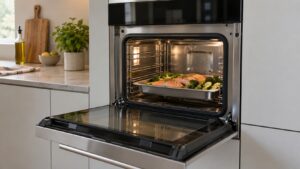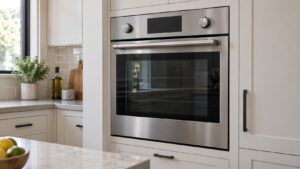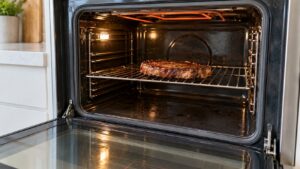
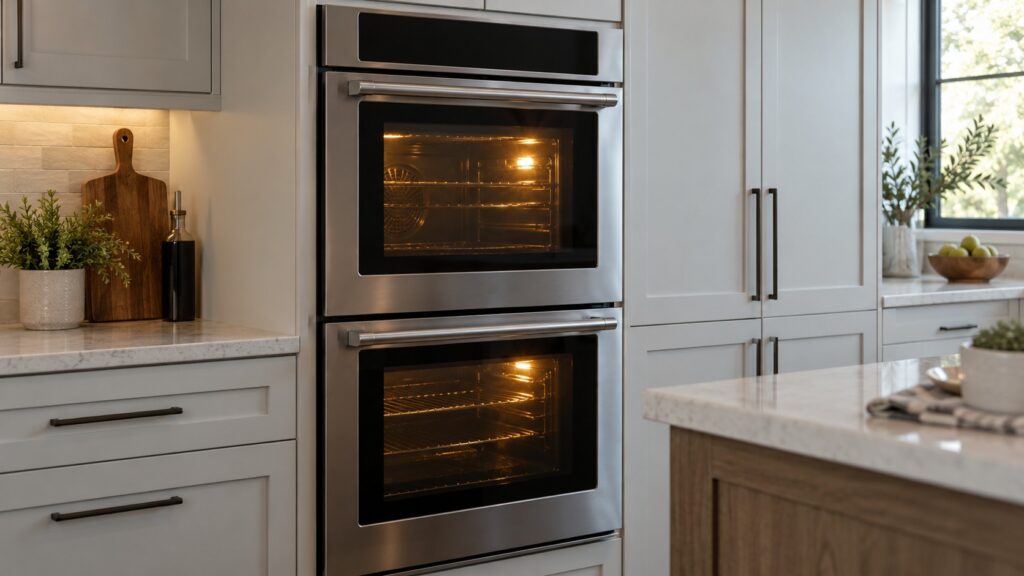
The Thermador oven cooling fan is not the same fan as the one that circulates air inside the cavity. It works outside the cooking space and moves air through the oven’s outer parts so that the controls and the cabinets around the oven do not overheat. On many built-in ovens it keeps running for a while after you switch the oven off, which is normal. What it does on your exact model, and how long it runs afterward, is in your owner’s manual.
What does the cooling fan do in a Thermador oven?
An oven reaches high temperatures inside, and the parts around the cavity must be kept cool. Insulation holds most of the heat in, but not all of it, and the electronics behind the control panel and the cabinets on either side would heat up over a long cook without help. The cooling fan moves air through the outer parts of the oven and sends the warm air out through a vent.
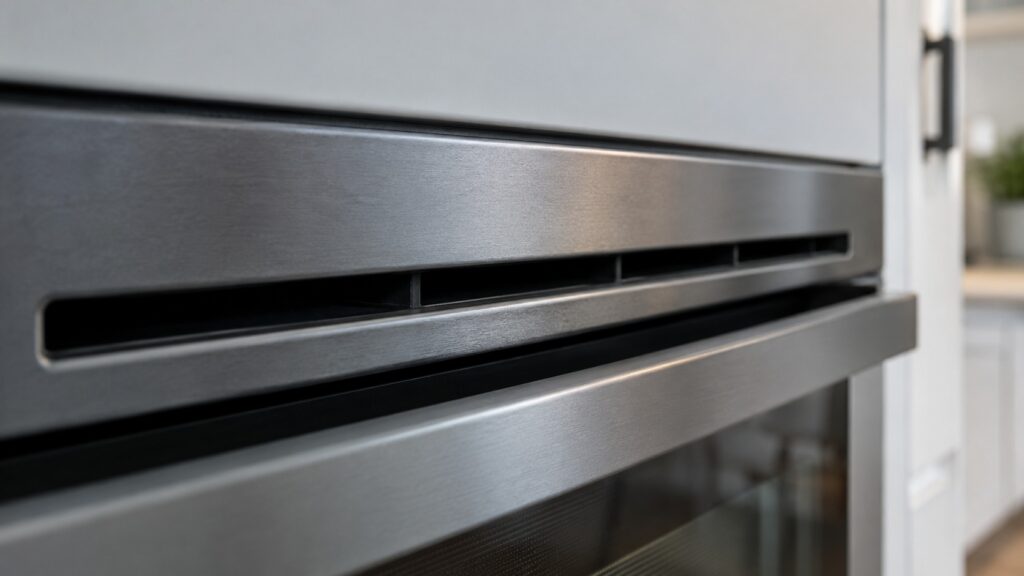
Our wall oven installation guide describes the airflow: wall ovens exhaust heat through a vent at the bottom of the unit, or behind the control panel depending on the model, and the cooling fan needs enough air circulation to protect the surrounding cabinets. That is why the guide says to leave the clearances in the installation manual and not to block the vent with cabinetry, drawers or stored items.
Why does the fan keep running after the oven is off?
Because the oven is still hot. When you turn the oven off, the cavity and the walls hold heat, and that heat has to go somewhere. On many built-in ovens the fan keeps moving air until the oven has cooled enough, and then it stops. A fan that runs for a while after a long bake is doing its job, and it is not a sign of a fault. Your manual describes what your model does.
How long it runs depends on the model and on how hot the oven was. Our pages give no figure for any model, and we will not invent one. If the fan keeps running long after the oven has cooled, or never stops, that is a different matter and worth a look.
How is it different from the convection fan?
The convection fan sits inside the cavity, behind the back wall, and circulates hot air around the food. Our True Convection explainer describes it. The cooling fan sits outside the cavity and cools the oven itself. They have different jobs, and a fault in one does not mean a fault in the other. On our oven code pages, E106 is listed as an upper oven convection fan motor failure, which is the convection fan, not the cooling fan.
Other Thermador appliances have cooling fans too. Our code pages list F8 as a cooling fan motor failure on ranges and E7 as a cooling fan failure with overheating risk on cooktops. The pattern is the same: the fan protects the electronics, and a failure is a reason to stop and call a technician.
What noises are normal, and which are not?
A steady rush of air, a low hum and a fan that rises in speed as the oven heats up are normal. The sound often seems louder in a quiet kitchen after cooking, because it continues when everything else has stopped. A fan that has changed in sound is a different story: a rattle, a grinding or scraping, a squeal or a fan that starts and stops can point to a problem with the fan or something touching it, and that is for a technician to find.
Check what you can from the outside. Make sure the vent is not blocked and nothing is stored under or against the oven. Do not remove the oven’s panels or reach in to look at the fan. Our Thermador oven maintenance guide covers what you can do yourself.
What if the oven or the cabinet gets too hot?
Treat it as serious. If the control panel is hot to the touch, the cabinet around the oven feels hot, you smell burning or the oven shuts down on its own, the cooling system may not be doing its job. Turn the oven off and let it cool with the door closed. Do not use it again until it has been checked. If you smell burning that does not fade or see sparks, switch off the breaker for the oven at the panel while standing on a dry floor, and do not use water.
The cooling fan matters for heat-sensitive electronics, so a fan that does not run is not something to live with. A technician can confirm whether the fan, its wiring or something else is the cause. We are an independent repair company, not the manufacturer. Our Thermador oven repair page explains how a visit works.
How can you help the fan do its job?
Keep the vent clear, keep the area around the oven free of paper, towels and storage, and clean the outside of the oven so dust does not build up near the vent. Do not cover the vent with a towel to catch drips. Leave the clearances the manual specifies, especially if cabinets have been changed since the oven was installed. A good installation matters here; our wall oven installation guide lists what the oven needs. If the oven is overheating, our oven troubleshooting pages help you rule out the simple causes first, and you can book a visit for the rest.