A Thermador refrigerator defrost system exists for one reason: the cold coil that chills the compartment, called the evaporator, collects frost from the moisture in the air, and frost blocks the airflow that makes the cooling work. In general, a frost-free refrigerator warms the coil from time to time just enough to melt the frost, and the meltwater runs away to a drain. How your model does this is in your owner’s manual. Our refrigerator temperature guide says that frost on the back wall of the freezer indicates a defrost failure blocking airflow, and that is a technician’s problem, not a chipping-with-a-knife one.
Why does a refrigerator need a defrost system?
Warm, humid air gets into a refrigerator whenever the door opens and with every load of groceries. When that air meets the very cold evaporator, the moisture freezes onto it as frost. A little frost does no harm, but a thick layer insulates the coil and chokes the airflow, so the refrigerator cools poorly while the compressor works harder. A defrost system stops that from happening by melting the frost before it builds up.
The water has to go somewhere. The melted frost runs down a small drain to a pan or a drain tube where it evaporates, which is why a clogged defrost drain can show up as water in the bottom of the cabinet. How your model manages this is in your owner’s manual, and our pages do not describe the parts in detail.
How does the defrost cycle work?
In a general sense, in three steps, though the details differ by model. The control decides it is time to defrost. The coil is warmed so the frost melts, and normal cooling pauses for the duration. When the frost is gone, the refrigerator ends the cycle and cooling resumes. You may hear a faint click, a trickle of water or a short pause in the sound of the fans, which can be part of normal operation; your manual says what is normal for your model.
The exact method, how often it runs and how long it lasts depend on the model, and we will not invent numbers. During a cycle the compartment can warm slightly, and then it recovers. That is why our guide describes small temperature swings as normal and larger swings as a sign of a problem.
Why do Thermador refrigerators have a defrost sensor?
A sensor is one way the control can know what is happening at the coil. Our refrigerator code pages list E13 as a freezer defrost sensor drift, with a defrost NTC sensor, wiring and a defrost board among the parts involved. A sensor that reads wrong can upset the defrost cycle and show up as frost or a warmer freezer. Because the sensor is only one part of the system, a code does not tell you which part has failed. Our guide to Thermador refrigerator error codes explains how to read what is on the display.
Thermador refrigerators have two compressors, one for the refrigerator and one for the freezer, each with its own evaporator, according to our dual compressor explainer says. That means each compartment has its own coil to defrost, and a problem can show up in one compartment and not the other.
What does frost on the back wall mean?
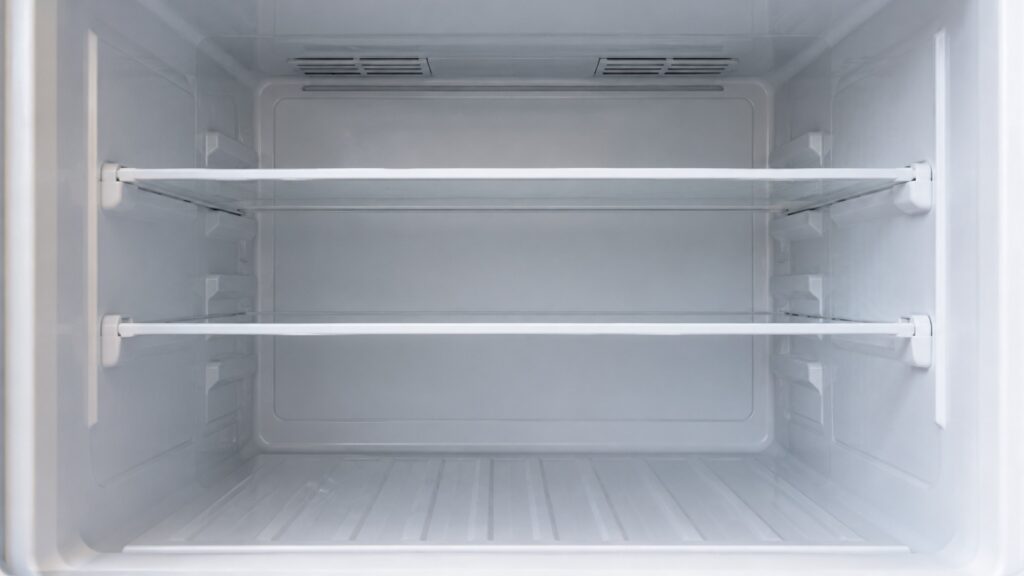
Our temperature problems guide says that checking for frost on the back wall of the freezer is a way to spot a defrost failure, and that on dual-compressor Thermador models the freezer has its own independent circuit, so frost buildup on the evaporator is a thing to check when the freezer is not cold enough. If you see heavy frost on the back wall, ice on the floor of the freezer or a thick layer on the food, the defrost system may not be keeping up.
Frost is not always a fault. A door left ajar, a gasket that does not seal or a big load of warm food will add frost for a while. Check that the door closes fully, that the gasket is clean, that nothing blocks the door and that the freezer is not packed solid, since an overpacked freezer blocks airflow and our guide advises leaving space between items. If frost keeps coming back, the cause is not your loading.
What should you do about a frosted freezer?
Keep the food cold first. Move it to a cooler or another freezer. Do not chip the ice with a knife or a screwdriver, which can puncture a coil and ruin the sealed system. Do not use a hair dryer or a heat gun near the back wall. Do not remove the back panel to look at the coil. If you decide to let the freezer thaw, follow your manual, protect the floor from water and do not restart it until it is dry.
The refrigerator will probably frost up again if the real cause is a failed heater, sensor or control, so a thaw is a stopgap, not a fix. Our refrigerator temperature problems guide lists the checks to make, and our freezer food safety guide tells you what to do with food when the freezer has warmed.
When should you call a technician?
Call when frost returns after you have checked the door, the gasket and the load, when the freezer is not cold enough, when water collects in the cabinet or on the floor or when a defrost code appears. Do not touch the sealed system or the wiring. If water reaches an outlet or the cord, switch off the breaker at the panel while standing on a dry floor, and do not pull the plug from a wet outlet. We are an independent repair company, not the manufacturer. Our Thermador refrigerator repair page explains how a visit works, and you can book a visit online.