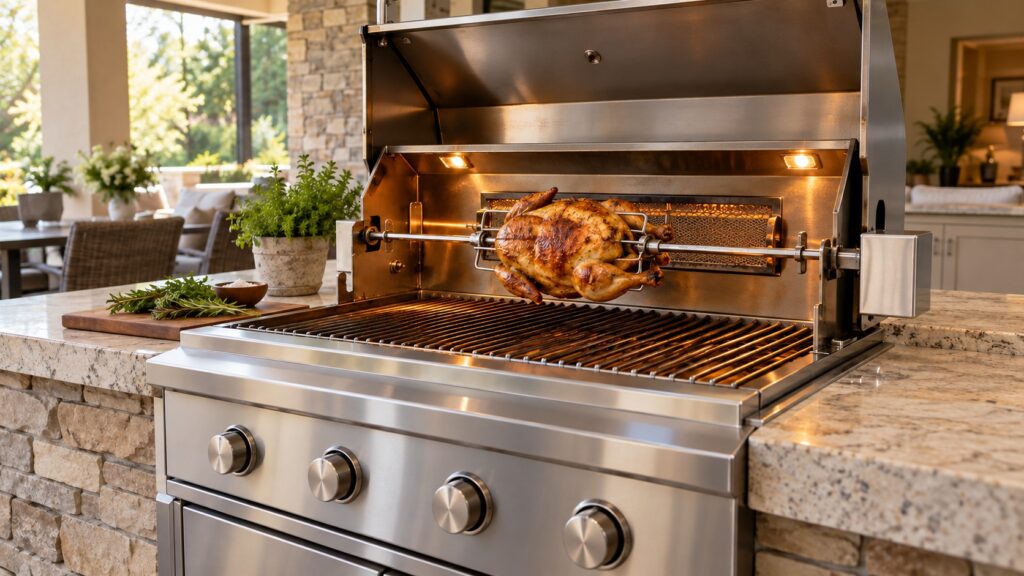
A Thermador grill rotisserie works by turning food slowly on a spit in front of a heat source, so it browns evenly all the way around and bastes itself in its own juices. On our site this feature is described on the page for the Thermador T42GR53BI, a 42-inch Professional built-in grill with a heavy-duty rotisserie system and a rear infrared burner. This guide explains how a grill rotisserie works in general, what the T42GR53BI page says, how to use one safely and when a rotisserie problem is a job for a technician.
How does a grill rotisserie work?
A rotisserie has three parts: a spit, which is a long rod that carries the food, a motor that turns the rod slowly, and a heat source positioned so the food passes in front of it as it turns. Because the food is always rotating, every side spends the same time near the heat. The juices that would drip off a flat roast run around the surface instead, and the skin or crust browns evenly. That is why rotisserie chicken, roasts and similar cuts are popular.
The key to a good result is balance. The food must be centered on the spit and secured so it cannot slide or flop, because a lopsided piece makes the motor work against gravity and cooks unevenly. Meat is usually tied or trussed so that legs and wings do not hang loose. Your owner’s manual explains how to fit the spit, the forks and any counterweight for your model.
What does the Thermador T42GR53BI page say about its rotisserie?
The T42GR53BI model page describes a Thermador Professional 42-inch built-in grill with a heavy-duty rotisserie system and a rear infrared burner. It also lists commercial-grade stainless steel construction and Home Connect Wi-Fi. That is the extent of what our page says: it does not give the motor power, the weight the spit can carry, the burner output or the cooking temperatures, so we do not state them here. The manual for the T42GR53BI has the figures, and you should rely on it for anything numerical.
Do not assume that every Thermador grill has a rotisserie. Our pages for the other grills in the line, such as the T36GG53BI or T42GG53BI, do not mention one in the same way, so check the model page and the manual for yours. Our grill glossary explains the other terms you will meet when you compare grill models.
What does the rear infrared burner do for a rotisserie?
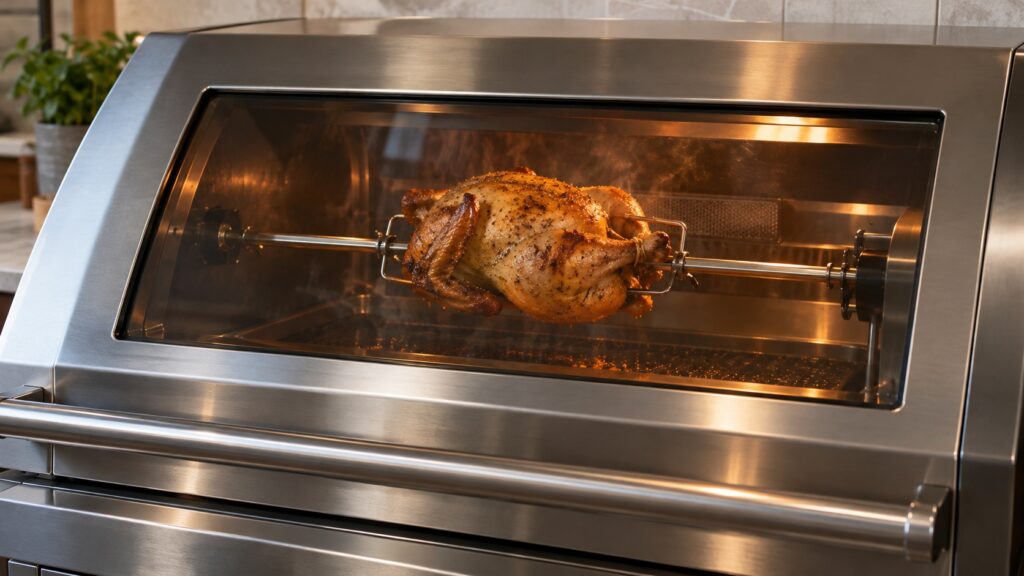
An infrared burner heats a surface until it glows and radiates heat directly at the food, instead of mainly heating the air around it. When it sits at the back of the grill, the spit turns in front of it, so the food is bathed in radiant heat as it rotates. Because the heat is radiant, it browns and crisps the surface while the inside cooks at the pace of the rest of the grill. Our guide on how Thermador infrared searing works explains radiant heat in more detail, using the searing zone as the example.
How you set the rear burner and the main burners for a rotisserie session, and whether the lid should be closed, is described in the manual for your model, and we do not invent a procedure. Lighting a gas grill is also done as the manual describes, with the lid open when it says so. Never improvise a lighting method.
How do you use a rotisserie safely?
A gas grill with a spinning spit needs a few simple habits. Keep the grill clear of overhangs, fences and anything that can catch fire. Keep children and pets away. Do not wear loose sleeves or dangling items near the spit, and use long, heat-resistant tools and gloves when you place or remove the food, because both the spit and the grill are very hot. Check that the food clears the burners and the grill walls as it turns, and stop if it catches.
Use a food thermometer and cook the food to the safe internal temperature published by the USDA for that kind of meat, since appearance alone is not a good guide. Let the meat rest after it comes off. Do not leave a lit grill alone. If a flare-up occurs because fat drips on a flame, turn off the burners and keep the lid closed to cut off the air; do not spray water on a grease fire. If you smell gas at any time, do not light anything or touch any switch. Move away from the grill and call your gas company or 911 from a safe distance.
How do you care for the rotisserie parts?
After the grill has cooled completely, wash the spit and forks as your manual describes, dry them and store them where they will not bend. Check that the spit is straight, the forks hold firmly and the thumbscrews or fixings tighten properly. Grease on the motor end or the socket can pick up debris, so wipe the area with a damp cloth when the grill is cold and never spray water into the motor socket. Our Thermador grill maintenance guide explains how to look after the rest of the grill.
A bent spit or a loose fork should be replaced, not forced into service, because it can cause an unbalanced turn and strain the motor. We do not recommend greasing the motor or opening the housing.
When does a rotisserie problem need a technician?
Call if the spit does not turn or stops under a normal load, if the motor makes a grinding noise, if you smell burning that is not from the food, or if the rear burner will not light. A motor, wiring and gas parts are not for owners to open or adjust. If you are not sure whether a problem is the load or the grill, remove the food and run the spit empty, as the manual allows, to see whether it turns smoothly. Our grill troubleshooting guide covers other common issues.
We are an independent repair company, not Thermador. See our Thermador grill repair page, or schedule a visit online.