
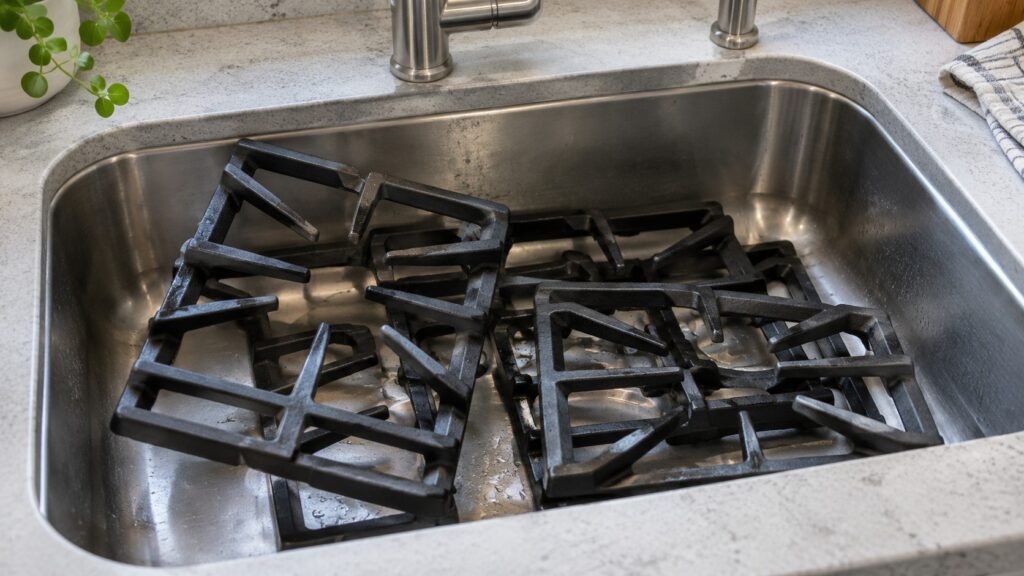
How to clean Thermador range grates comes down to a short routine: let the cooktop cool completely, lift the grates off, wash them in hot soapy water, dry them right away and wipe on a thin coat of cooking oil. Our range maintenance guide says the same in four lines for cast iron grates: wash with hot soapy water and dry immediately, apply a thin coat of cooking oil to prevent rust, never put them in the dishwasher because the detergent strips the seasoning, and soak overnight in hot water with baking soda for stubborn buildup.
How do you clean Thermador range grates?
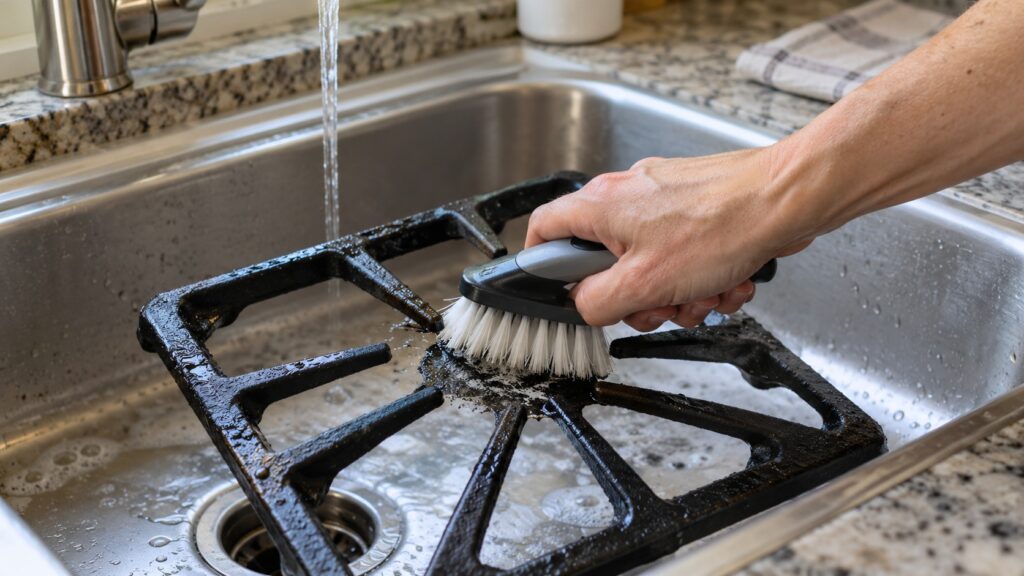
Wait until the grates have cooled. Cast iron holds heat for a long time, so touch the surface lightly to be sure before you lift. Lift each grate straight up and carry it to the sink. Wash it with hot soapy water and a stiff brush, rinse, and dry it completely with a towel straight away. Water left on cast iron will leave rust spots within a short time.
Once dry, rub a thin coat of cooking oil over the surface with a paper towel. A thin film is enough; thick oil turns sticky. That is the weekly routine in our range cleaning and maintenance guide, and it is what keeps the grates black and smooth rather than gray and rough.
What if the grates have baked-on residue?
Soak, then scrub. Our cooktop cleaning guide says to soak the grates overnight in hot water with baking soda and then scrub. A bathtub or a large sink works if the grates are big. Use a stiff brush or a non-scratch scouring pad, and keep at it until the residue lifts. If a spot will not come off, repeat the soak instead of reaching for something harsh.
Avoid commercial oven cleaner and aggressive chemicals on grates. We do not list them as safe for these surfaces, and what gets into the pores of cast iron can end up near food. Your owner’s manual is the final word for your model; if it says something different from this guide, follow the manual.
Why should you never put cast iron grates in the dishwasher?
Our guide says the detergent strips the seasoning. Seasoning is the thin, baked-on layer of oil that protects cast iron from rust and gives it a smooth, dark finish. Without it the grates rust quickly. The dishwasher also leaves the grates wet and warm, which is how rust starts. Hand washing and immediate drying is the safer method.
If your grates already show rust, scrub it off with a stiff brush, wash the grate, dry it thoroughly and oil it. If the rust is deep or the metal is flaking, ask a technician or check the manual about replacement grates.
What about re-seasoning after a deep clean?
After a long soak and a hard scrub, the finish can look dull and dry. That is the moment to add a thin coat of cooking oil. Our cooktop cleaning tips also describe a full re-seasoning step after deep cleaning, with vegetable oil; check your owner’s manual before you heat anything. Store spare or removed grates somewhere dry, and look them over for chips or cracks while you have them in hand.
How often should you clean them?
Our maintenance guide places grate care in the weekly routine alongside the Star Burner caps, and our cleaning tips page says to clean the cooktop after every cooking session so that spills do not become harder to remove. A practical rhythm is a wipe after use when the surface is cool and a full wash weekly, or sooner after a boil-over.
Cooktops with Star Burners have a set of continuous grates, which our site describes as letting you slide heavy pots from burner to burner. Continuous grates are large, so lift them with both hands and take care not to chip the cooktop. Set them down on a towel.
What should you do with the burners while the grates are off?
Leave them alone. Do not turn a knob or try to light a burner with the grates removed, and keep the burner caps seated and flat. Our care guide says each cap must sit flat and aligned with the burner base, because misalignment causes uneven flame and ignition problems. See our Star Burner guide for cap and port care, and wipe up spills around the burner heads with a damp cloth, keeping water out of the ports.
Put the grates back after they are dry, making sure each one sits properly on its seat and does not rock. Then check that every burner lights the way it did before. If one does not, do not force it. Our guide to a Thermador burner that will not light covers the checks that are safe for you, and our guide to a yellow burner flame covers a flame that looks wrong.
When should a technician look at it?
Grates are a cleaning job. Anything that touches the gas side is not. If you smell gas, do not turn anything on or off and do not light anything; leave the house and call the gas utility or 911 from outside. If a burner will not light after the grates and caps are clean and in place, or the flame is uneven, book a visit instead of trying to fix the gas parts.
We are an independent repair company, not the manufacturer. Thermador range repair starts with a diagnostic visit, and we confirm the estimate before any work begins.