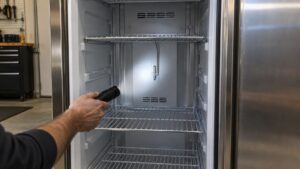
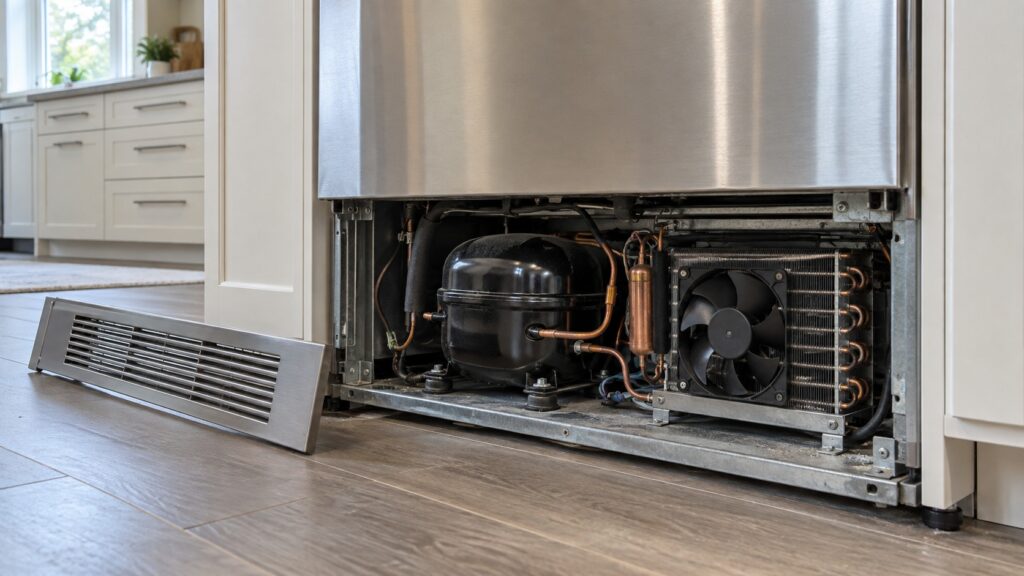
A Thermador refrigerator E11 is a compressor communication error: the main control board is no longer getting an answer from the inverter that drives the compressor. Nothing is broken about the cold air yet, which is why this code so often appears on a refrigerator that still feels perfectly normal inside. The board is reporting that it has lost the conversation, not that the food has warmed up.
Three codes on this site sit on the same run of wiring, and telling them apart saves a wasted afternoon. Here is what each one says on its own page.
What does a Thermador refrigerator E11 mean in plain terms?
A column refrigerator does not switch its compressor on and off like an old appliance. It runs a variable speed compressor through an inverter, a small power module that turns the supply into whatever frequency the compressor needs right now. The main board tells the inverter what speed to hold, and the inverter answers back. E11 is raised when the answer stops arriving.
That has a practical consequence people rarely expect. A compressor already running at a steady speed can keep running for hours after the board loses contact with it, because the inverter holds its last instruction. So the first sign is a code on the display and food that is still perfectly cold. The second sign, usually the next morning, is a cabinet that has drifted up several degrees because nothing was able to ask for more cooling.
How is E20 different from E11 on the same refrigerator?
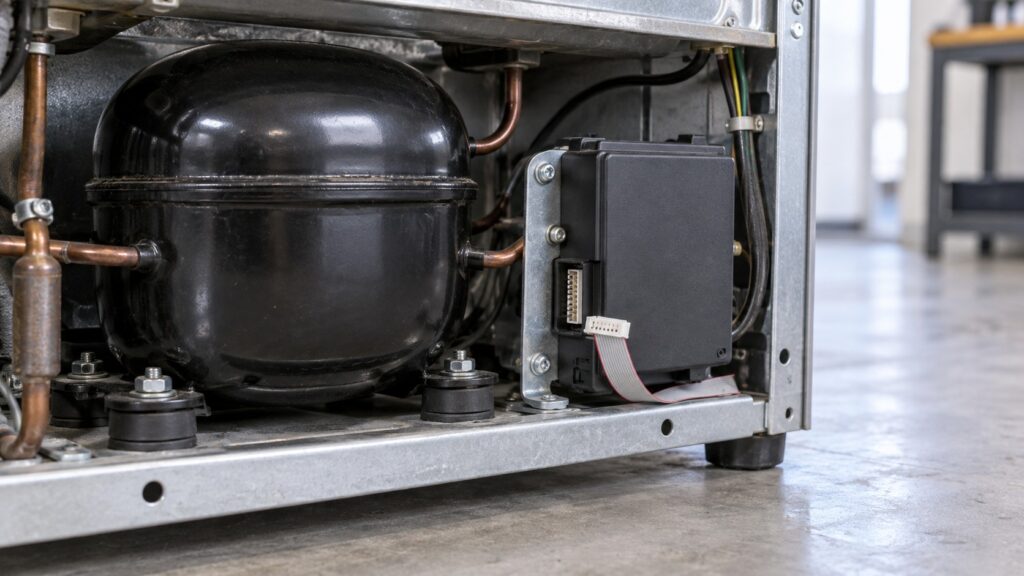
E11 is silence. E20 is a complaint. With E20 the inverter is still talking and is reporting its own internal fault: the variable speed drive has detected something it cannot work through, and it has stopped driving the compressor. That is why E20 tends to arrive with a cabinet that is genuinely warming, while E11 can sit on the display for a day with nothing else wrong.
The practical difference is where a technician starts. A Thermador refrigerator E11 is chased along the harness first — connector, routing, the plug at the inverter, the plug at the board. E20 points at the inverter module itself, and the module is almost always replaced rather than repaired. Both live at the bottom of the cabinet in the machine compartment, behind the base grille, which is the part of the appliance that collects the most dust and the least attention.
Why does E04 keep coming back after the reset?
E04 is the compressor stopping itself on thermal protection. A motor that is being asked to work in a hot machine compartment will trip, cool down, restart, and trip again, and each round looks like the code is random. It is not random. Something is stopping the heat from leaving.
The most common reason is the condenser: either the fan has failed, which this site files as E03, or the coil and the fan blade are packed with dust and pet hair. A built-in column has no room to spare. It vents through the base grille and through the top of the cabinet, and if either path is blocked the machine compartment simply gets hotter until the compressor objects. Cleaning the condenser is covered in our refrigerator maintenance guide, and it is the one job on this page that is entirely safe to do yourself.
What can I check before calling anyone?
Four things, in this order, and none of them requires a tool that is not in a kitchen drawer.
- Read the actual cabinet temperature with a thermometer in a glass of water on a middle shelf, not the display. A code with correct temperatures is a different conversation than a code with warm food.
- Pull the base grille and look at the condenser. A visible mat of dust across the coil explains E04 on its own. Vacuum it with the refrigerator unplugged.
- Put a hand near the grille while the refrigerator runs. Moving air means the condenser fan is alive. No air with a warm compartment is an E03 story.
- Cut power for five minutes at the breaker and restore it. If the code returns within the hour, it is a real fault rather than a startup glitch.
🔴 Stop there. The inverter module sits on mains voltage and holds a charge in its capacitors after the power is cut, and the compressor terminals are live whenever the appliance is plugged in. The machine compartment is not a place to probe with the power on.
Which codes look similar but point somewhere else?
E09 is refrigerant pressure out of range. It is a sealed system finding and it has nothing to do with the inverter, even though the compressor is involved in both. E15 is a communication error too, but between the two halves of a Freedom column pair rather than between board and inverter, so a refrigerator and a freezer installed side by side can raise it while both compressors are perfectly healthy.
If the cabinet is warm and no code is showing at all, the problem is upstream of this page entirely. Start with Thermador refrigerator temperature problems, and if you want the design context, how the dual compressor system works explains why one half of a column can be right while the other is wrong.
When does this become a service call?
Any of these codes that survives a clean condenser and a power cycle is service work. So is E20 in every case, because a drive that reports its own failure is not going to be talked out of it, and so is E11 that turns into warm food. Replacing an inverter module means discharging it, matching the part to the compressor, and confirming that the board and drive talk again under load. Replacing a compressor means opening the sealed system, which is refrigerant work.
We are an independent repair company, not a factory service arm. Pricing starts from a diagnostic visit and we confirm the estimate before any work begins. Thermador refrigerator repair covers inverters, condenser fans, sensors and sealed systems, and you can schedule a visit online. If the cabinet is already warming, move what matters into a cooler first — a refrigerator that has lost control of its compressor speed does not warm up evenly, and the top shelf goes first.