Thermador ThermaFresh is a controlled storage zone inside the refrigerator — a drawer held at its own temperature and humidity rather than taking whatever the main compartment happens to be doing. The point is not that it is colder. The point is that it is steadier, and steadiness is what actually decides how long fresh food lasts.
Why a separate zone beats a colder shelf
Every time the refrigerator door opens, the compartment loses cold air and the temperature rises — by a few degrees for a few minutes, several times a day. Food on an open shelf rides that swing constantly, and it is the swing rather than the average that shortens shelf life. Proteins in particular lose days to it.
A sealed drawer with its own control is insulated from that. The door opening barely reaches inside it, and the drawer’s own system brings it back quickly. Fish that lasts two days on a shelf commonly lasts noticeably longer in a controlled drawer at the same nominal temperature, and nothing about the food changed — only the stability.
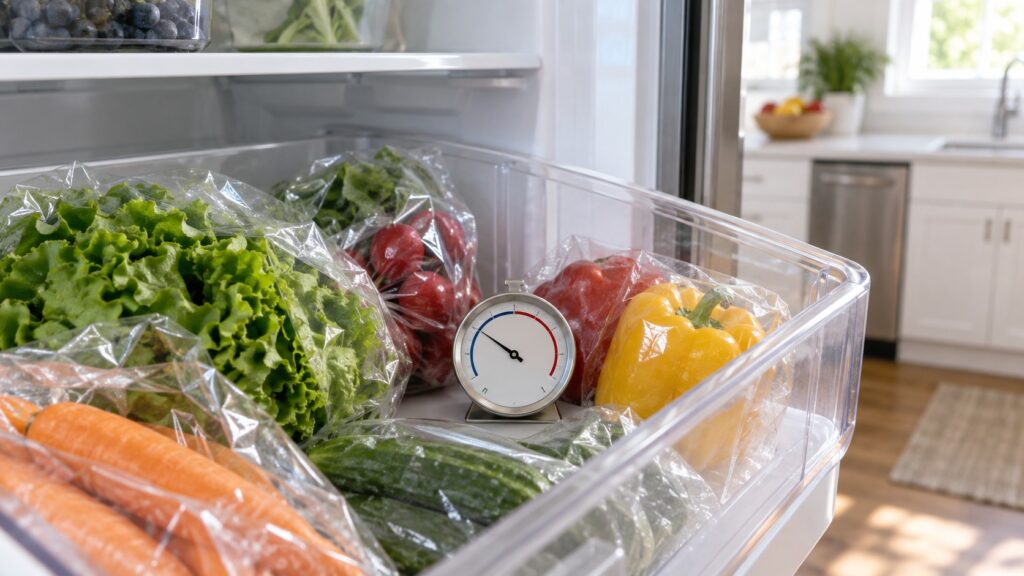
Temperature and humidity are two separate decisions
Temperature decides how fast biological processes run. Humidity decides whether food dries out or sweats. They are independent, and the mistake people make is treating the drawer as a single “fresher” setting rather than as two choices.
- Cold and humid — fish, shellfish, delicate proteins that dry quickly.
- Cold and drier — cured meats and hard cheese, which mold in high humidity.
- Warmer and humid — leafy greens and herbs, which suffer chilling damage at the coldest settings.
- Warmer and drier — apples, pears and stone fruit, which give off ethylene that needs somewhere to go.
What goes in it, and what should not
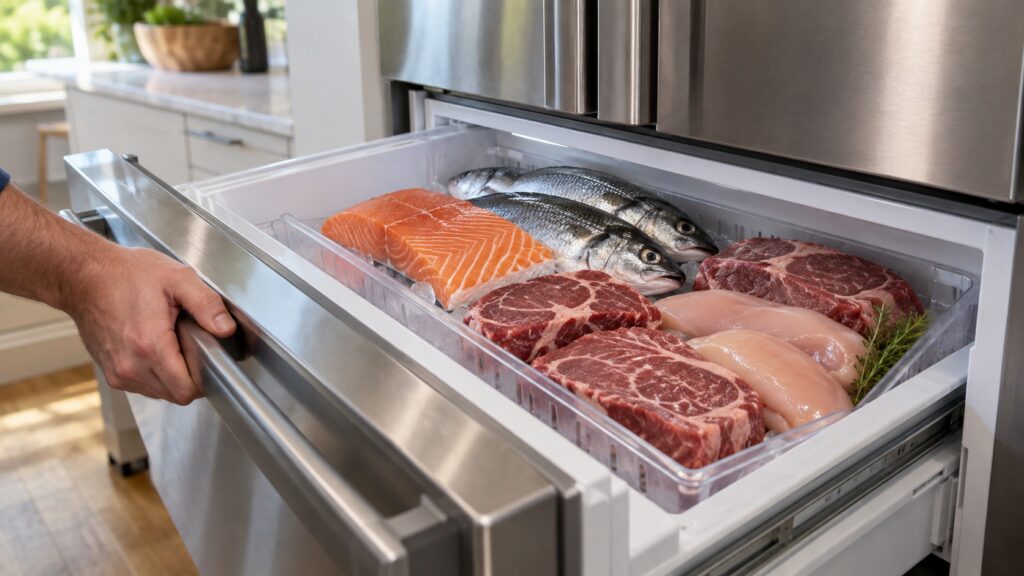
Raw meat and fish are the clearest case: they gain the most days and they belong low in the appliance anyway, where a drip cannot reach anything below. Cheese benefits, particularly softer styles that dry out on an open shelf. Charcuterie keeps better in a controlled drawer than anywhere else in a domestic kitchen.
What should not go in it is anything you open constantly — milk, drinks, condiments. Every opening costs the drawer its advantage, and those things are perfectly happy on a shelf or in the door. Our refrigerator organization guide covers the rest of the layout.
What actually spoils food, and which of it this addresses
Three processes run in parallel in a refrigerator, and a controlled drawer only helps with two of them. Bacterial growth slows sharply as temperature falls toward freezing — this is where a colder setting genuinely earns its place with proteins. Enzymatic ripening continues at any refrigerator temperature and is what softens fruit; a drawer slows it but cannot stop it. And moisture loss is purely a humidity question, which is why a perfectly cold shelf still leaves greens limp.
Knowing which process you are fighting decides the setting. Fish is a bacteria problem: go as cold as the drawer allows without freezing. Greens are a moisture problem: humidity up, temperature moderate. Apples are an ethylene problem: humidity down so the gas can escape. One drawer cannot serve all three at once, which is why models with two controlled zones are more useful than the specification suggests.
Packaging still matters inside it
A controlled drawer manages the air around the food; it does not replace wrapping. Fish left unwrapped in a low-humidity drawer dries at the surface; the same fish sealed keeps beautifully. Cheese sealed in plastic in a high-humidity drawer sweats and molds, while the same cheese in paper does not.
The rule that works is to let the drawer handle the environment and let the wrapping handle the exchange between food and that environment. Loose paper for cheese and charcuterie, a sealed container or a tight wrap for raw protein, nothing at all for whole fruit in a low-humidity setting.
How it relates to the rest of the appliance
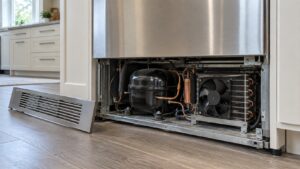
A controlled drawer works alongside the main cooling system rather than instead of it, so a refrigerator with a problem elsewhere will show it here too. If the whole appliance is struggling, the drawer cannot compensate — see our page on temperature problems.
On models with a dual compressor arrangement, the fresh-food and freezer sides are independent, which is a different kind of separation and worth understanding alongside this one: how the dual compressor works.
What a drawer that has stopped working looks like
Three symptoms are worth separating. Food spoiling faster than it used to, with the main compartment fine, points at the drawer’s own control or sensor. Ice forming inside the drawer means it is running below freezing — a control fault rather than a setting, and it will ruin produce quickly. And a drawer that reads correctly but no longer holds means the seal around it, which is the part that makes the whole thing work.
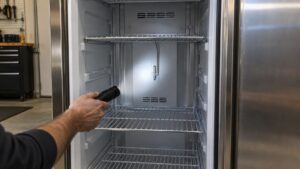
A drawer that simply feels the same as the rest of the refrigerator is the subtlest failure, because nothing looks wrong. If food is not keeping the way it did, compare the drawer against a shelf with a thermometer over a day rather than assuming.
Getting the most from it
Set it once and leave it. A controlled drawer works by stability, and adjusting it every few days defeats the entire mechanism. Fill it reasonably — thermal mass helps here as everywhere. Keep it closed, which sounds obvious and is exactly the habit that separates households who get value from it and those who do not.
We are an independent repair company, not a factory service arm. Pricing starts from a diagnostic visit and we confirm the estimate before any work begins. Thermador refrigerator repair covers the controlled zones along with the main system, and you can schedule a visit online.