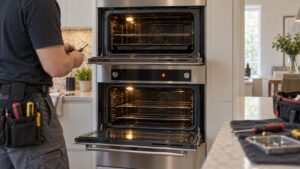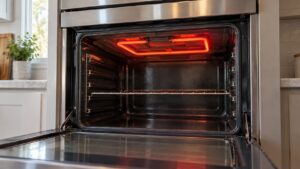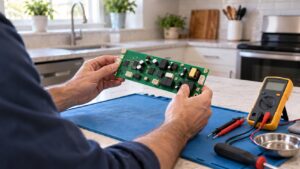
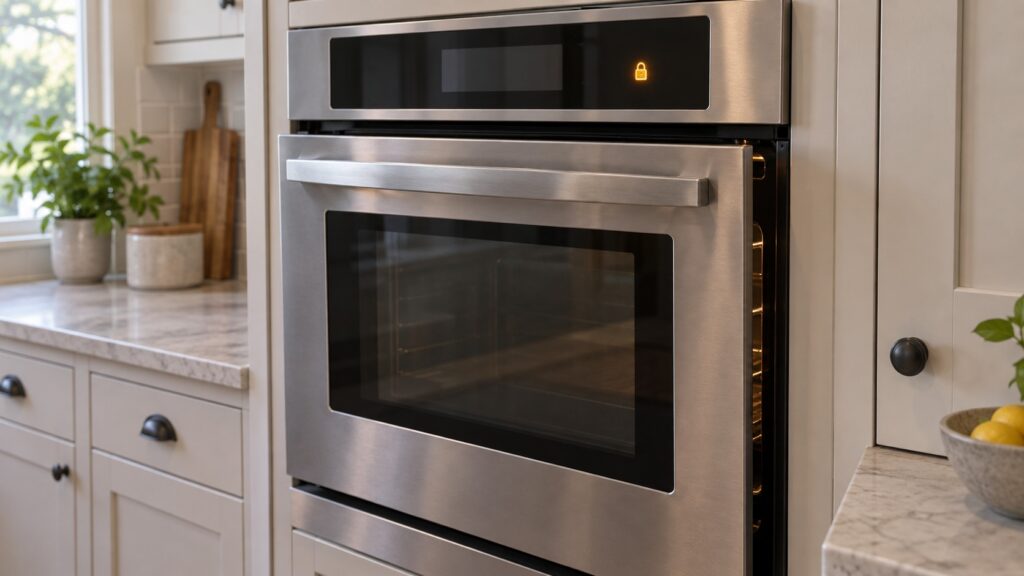
A Thermador oven E005 is a door lock motor timeout: the board told the latch to move, waited for the switch that confirms it arrived, and gave up. The code says nothing about heat, sensors or elements. It says the lock did not finish its trip in the time allowed, and that is why the oven refuses to start the cycle that needed it.
Two states produce the same code, and they feel completely different from the kitchen side.
What is the lock, and why does an oven need a motor for it?
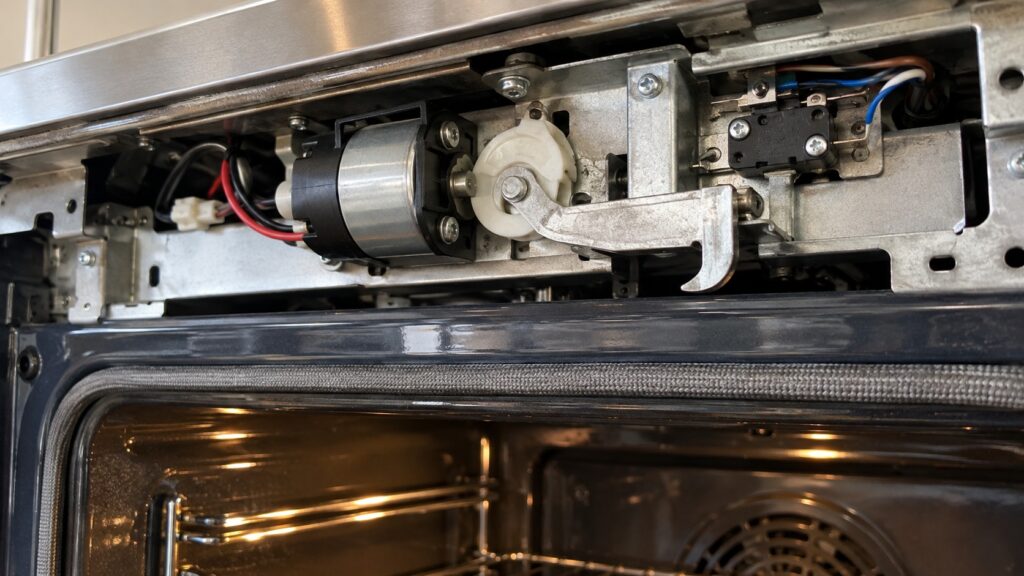
The latch that holds an oven door shut during cleaning is not the spring catch that keeps the door closed while you bake. It is a separate assembly across the top of the cavity: a small motor, a cam, a steel hook that swings into a keeper on the door, and one or two microswitches that report position back to the board. The board will not raise the cavity to cleaning temperatures until a switch tells it the hook is home, and it will not release the door until the cavity has cooled below a set temperature.
That chain has a deadline built into it. The motor is expected to complete its travel in a few seconds. If the confirming switch has not changed state by then, the board stops rather than keeps trying, and that timeout is exactly what a Thermador oven E005 reports. The fault is therefore almost never the motor by itself — it is anything that keeps the hook from arriving, or keeps the switch from noticing that it did.
What actually stops the latch from getting home?
In descending order of how often it turns out to be the answer:
- Mechanical obstruction. Residue that baked into a hard glaze during a cleaning cycle, a rack pushed against the door, or the door itself sitting fractionally low on worn hinges so the hook and the keeper no longer line up.
- A failed microswitch. The motor completes its travel and nothing reports it. The lock looks right and the code appears anyway, which is the most confusing version of this fault.
- Door alignment. A door that has been slammed, or a hinge spring that has weakened, moves the keeper a small distance, and a small distance is enough.
- The motor or its gear train. A nylon gear with a stripped tooth stalls partway, which also produces a faint buzzing when the cycle is requested.
- The harness. The lock assembly is at the top of a cavity that reaches self-clean temperatures, and its wiring ages faster than anything else in the appliance.
The door is locked shut. How do I get it open?
Patience first, force never. Confirm the cavity is cold by touching the outer door glass and by giving it two full hours after the cycle ended. Then cut power at the circuit breaker for five minutes and restore it. Many boards run the lock through a homing routine at startup, and a latch that stalled on debris will often complete its travel on that attempt.
If that fails, request another cleaning cycle and cancel it immediately. That drives the motor toward locked and then back toward unlocked, and the second direction is the one you want. 🔴 Do not pry the door, do not lever the hook with a screwdriver through the gap, and do not remove the outer door panel to reach the latch. The hook is steel and the door skin is not; the usual result of prying is a bent door that no longer seals, which converts an electrical repair into a door replacement.
Why does E005 usually appear right after a self-clean cycle?
Because that is the only time most households ask the lock to work. A latch can sit unused for two years while the oven bakes perfectly well, and the grease film and cleaning residue accumulate around it the entire time. Then a cleaning cycle is started, the motor is asked to move for the first time since the last one, and it either cannot or is not believed.
It is also the cycle that punishes any existing weakness. Self-clean runs the cavity far above cooking temperatures, and the door and its frame expand more than in any normal use, so a hinge that has dropped by a small amount shows up as a misaligned keeper only at that temperature. That is worth knowing before the cycle: an oven whose door already needs a firm push to close is not an oven to leave on a cleaning cycle overnight. Regular cleaning by hand, as in our wall oven maintenance guide, keeps the latch out of that position in the first place.
Is this the same as the door not closing properly?
No, and the two get mixed up constantly. A door that drifts open, closes with a thud, or no longer pulls itself shut at the end of its travel is a hinge and damper question, covered in our guide to the SoftClose door. That mechanism is about how the door moves. The lock is about whether a steel hook has engaged and reported itself, and it only ever acts during a cleaning cycle.
They do meet in one place. Worn hinges change where the door sits when closed, and where the door sits is what the hook has to find. So a SoftClose complaint that has been ignored for a year is one of the ordinary roads to E005.
When does this become a service call?
When the door will not release after a cooled cavity, a power cycle and a canceled clean cycle, and whenever the code returns on a second attempt. The lock assembly sits above the cavity liner behind the control panel, its switches are wired into the same board area as the heating relays, and getting to it on a built-in oven means working on an appliance fixed into cabinetry. If the door is locked with food inside, say so when you book, because that changes how the visit is scheduled.
We are an independent repair company, not a factory service arm. Pricing starts from a diagnostic visit and we confirm the estimate before any work begins. Thermador oven repair covers door locks, hinges, switches and control boards, and you can schedule a visit online. If your appliance is a range rather than a wall oven, the equivalent code is listed in Thermador range error codes.