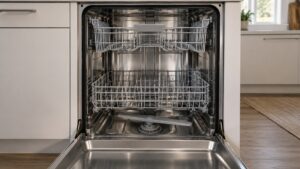
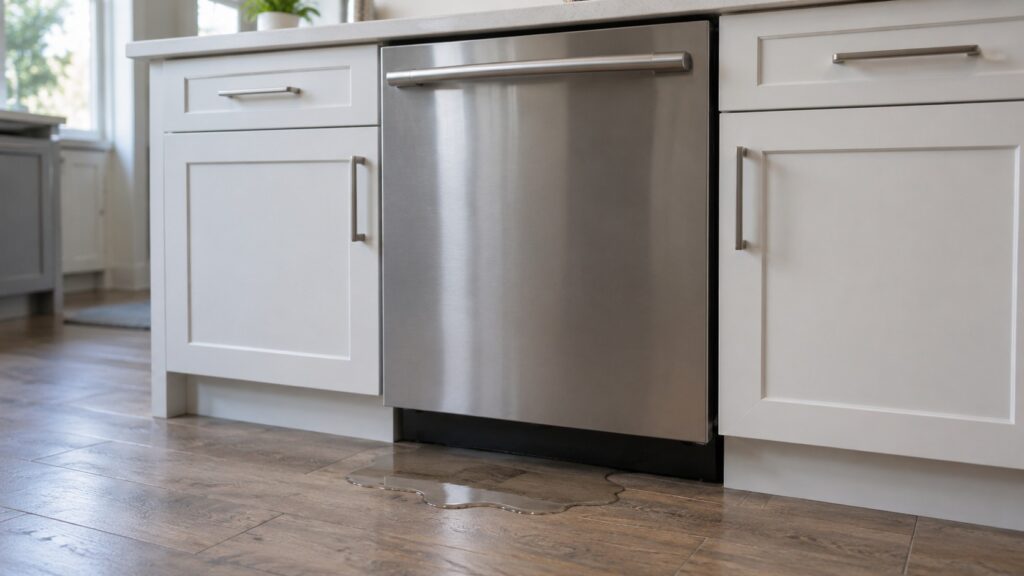
A Thermador dishwasher leaking water usually means water has escaped from the tub, a door seal, a hose connection or a pump seal, and the place the water appears tells you where to look: at the bottom edge of the door points to the door gasket or the spray, a puddle underneath points to the base, hoses or pump, and water at the sink cabinet points to the supply or drain hose connections. Our site lists error code E15 for water detected in the base pan, which means the leak protection has triggered. Stop using the dishwasher, protect the floor and find out which case you have before the next cycle.
Why is my Thermador dishwasher leaking?
Our E15 page lists the usual internal causes: a cracked sump housing, a failed tub-to-pump seal, a loose hose clamp, a worn door gasket that lets water drip into the base, or condensation from a blocked vent. On Star Sapphire models it also mentions the third rack spray connection, where the junction fitting can develop leaks. Our maintenance guide adds that door gaskets and hose connections develop micro-leaks over time.
Not every leak is internal. A supply or drain hose connection under the sink can drip, and so can the valve where the supply meets the tap. That is why the first job is to work out where the water first shows up, not to guess.
What should you do first?
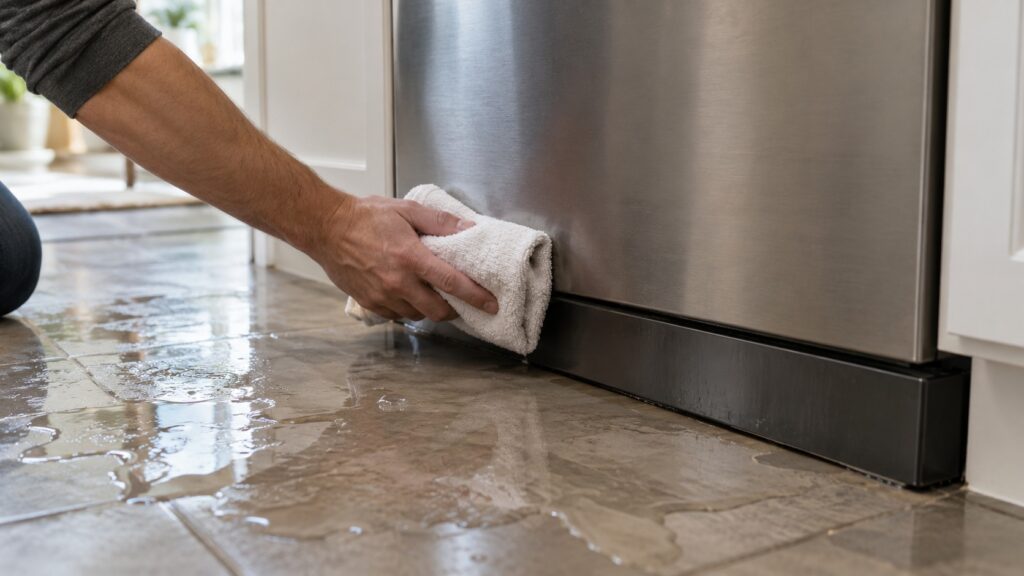
Stop the dishwasher and turn off its water supply at the valve under the sink. Dry the floor and the area around the dishwasher so you can see where new water appears, and lay a towel or a shallow tray to catch drips. Do not run another cycle to see what happens.
If water has reached an outlet, the power cord or anything electrical, switch off the dishwasher’s breaker at the panel while standing on a dry floor, and do not pull a plug from a wet outlet. Keep children and pets away from wet floors.
Take a photo of where the water first appeared, and note any code on the display. That helps a technician find the source faster.
What is E15 on a Thermador dishwasher?
Our E15 page describes it as water in the base pan, an anti-flood sensor that has been triggered. The dishwasher stops and runs the drain pump to limit damage. The page classes it as a high-severity issue that needs a technician, and says not to keep using the dishwasher with an active E15, because water in the base pan can damage the motor, the control board and the flooring beneath the unit.
The page includes a procedure that involves pulling the unit out and tilting it. We do not recommend that for a built-in dishwasher; it is heavy, it is connected to water, drain and power, and a mistake can cause damage or injury. If E15 appears or returns, book a visit.
E15 is also the sign that the protection is working. Our explainer on how Thermador AquaStop works describes three layers: a float sensor in the base pan, a double-wall supply hose and an electric shutoff valve at the tap connection. When the base pan sensor triggers, the water intake stops and the drain pump runs.
What can you check from the front?
Look at the door seal. A gasket that is torn, flattened or dirty can let water escape at the door edge. Wipe it with a damp cloth and a drop of dish soap and look for cracks or gaps. Check that nothing is hanging out of a rack and holding the door slightly open.
Look at the loading. Large items can block a spray arm or deflect water toward the door. Our dishwasher loading tips explain how to load so the arms can turn freely.
Use dishwasher detergent only. Our troubleshooting guide says to use a quality detergent tablet, not liquid soap. If water is standing in the tub or the dishwasher seems to fill and not drain, read our guide to a Thermador dishwasher that is not draining, which covers the drain filter and the drain hose.
What should you leave to a technician?
Anything inside or underneath the dishwasher. Do not pull the unit out of the cabinet, tilt it, remove the lower panel or open the pump area. Do not tighten hose clamps or loosen supply connections on a unit that has water and power connected. Those are the places where a cracked sump, a seal or a clamp fails, and finding them means access to the interior.
Our installation guide says the AquaStop valve mounts at the supply valve connection, not at the dishwasher, and that old supply hoses should not be reused, so a technician will check the connections as part of the visit. If water is coming from inside the cabinet wall, shut off the supply and call right away.
Is it worth repairing?
Often, yes. A seal, a clamp, a gasket or a hose is usually far cheaper than a new built-in dishwasher, and a diagnosis shows which part has failed. The picture changes if the unit is old and needs a major repair, or if the leak has already damaged the base or the electronics. Our dishwasher repair versus replace guide explains how to think about it.
We are an independent repair company, not the manufacturer. Thermador dishwasher repair starts with a diagnostic visit, and we confirm the estimate before any work begins.