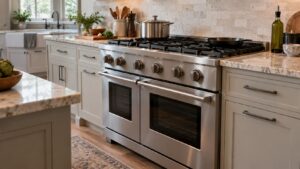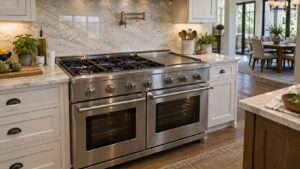
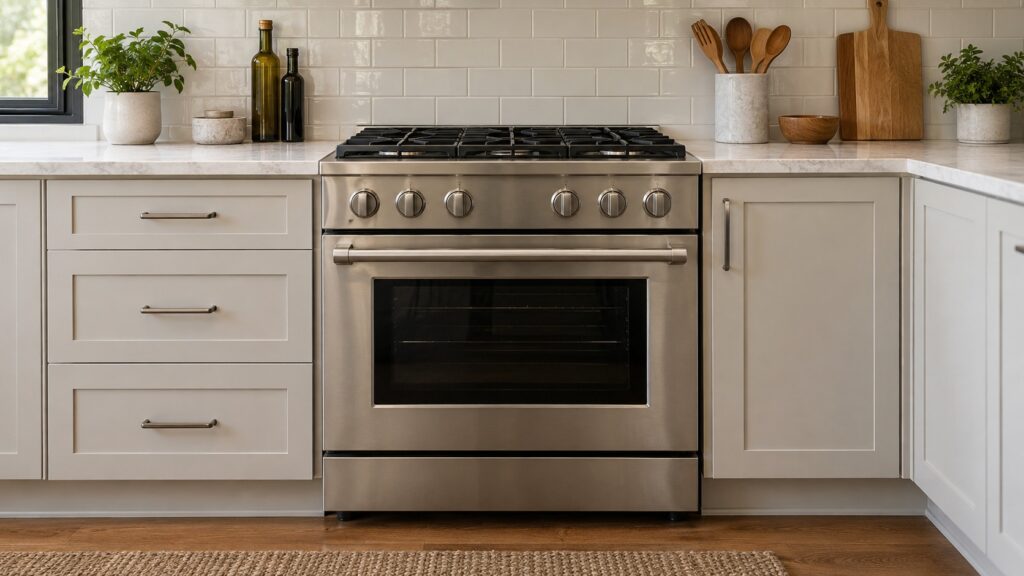
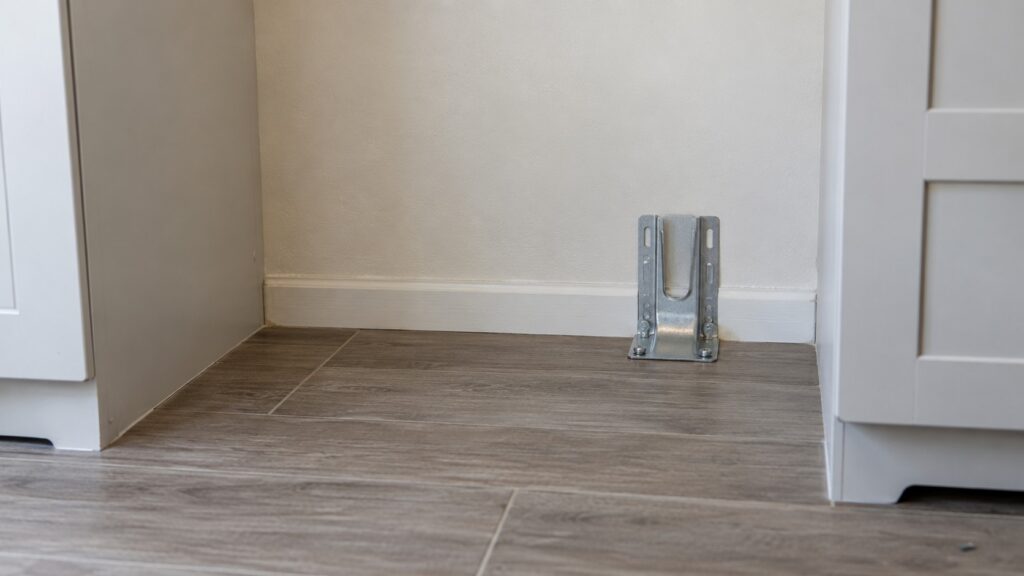
A Thermador range anti-tip bracket is the small metal bracket that holds the back of the range to the floor or the wall so the range cannot tip forward. Tipping happens when a lot of weight lands on an open oven door, such as a child climbing on it or a heavy roasting pan being set on it. Our range installation guide says all Thermador ranges must be secured with the included anti-tip bracket, and that it is a safety requirement, not optional. The bracket is fitted by the installer, following the installation instructions for your model.
What does an anti-tip bracket do on a Thermador range?
A range is tall compared with its base, and an oven door that opens downward works as a lever. When weight is put on the open door, it sits in front of the range’s front feet, and the range can rotate forward. The bracket secures the back of the range and keeps it from lifting.
The effect is simple but easy to forget. A range that is not secured can look perfectly stable and still tip when a child pulls on an open door or someone uses it as a step. It is also a risk with a full roasting pan on a pulled-out rack. The bracket does not change how the range cooks; it only keeps it where it belongs.
Which Thermador ranges need the bracket?
All of them, according to our Thermador range installation guide. That covers the Professional, Pro Harmony and Pro Grand ranges. Our model pages list ranges from 30 inches to 60 inches, such as the PRG304GH Pro Harmony 30-inch gas range and the PRD486WDGU Pro Grand 48-inch dual fuel range, and a wider and heavier range is not a reason to skip the bracket. If anything, the opposite is true.
The exact bracket type and how it is fitted depend on the model and the construction of your home. Those details are in the installation instructions that came with your range, and our pages do not give them.
Who should install the anti-tip bracket?
The installer, as part of putting the range in. A gas range or a dual fuel range is connected to a gas line, and the same visit sets the range level, connects the supply and secures the bracket. Do not move a gas range to get at the bracket: it is connected to the gas line, and pulling it can damage that connection. Our Thermador range safety guide covers the general habits that go with a gas range.
If you are having a range delivered, ask the installer to show you, before they leave, that the bracket is installed and that the range is engaged with it. Ask the installer to confirm it in writing or show you before they leave. If you moved into a home with a range already in place, you cannot be sure it is secured unless someone has checked.
What should you do if you are not sure the range is secured?
Do not try to test it by pushing, pulling or tilting it, and do not pull a gas range out from the wall. If you smell gas at any time, do not turn anything on or off, do not light anything, leave the house and call your gas utility or 911 from outside. If you are unsure whether the range is secured, a technician or an installer can check, and our Thermador range repair page explains how a visit works. Tell them what you want checked when you book.
Until it has been checked, keep weight off the open oven door and keep children away from it. Make it a household rule that nobody sits or stands on the oven door.
What if you are replacing a range or moving it?
Any time the range has to be moved for a floor repair or a replacement, the bracket has to be secured again when the range goes back. A range that has been moved and slid back into place can look fine without being secured, so ask the installer or technician to confirm it. Our Thermador cooktop installation guide and the wall oven installation guide cover the related installations, which do not need an anti-tip bracket because they are built in.
The same caution applies to a range in a rental or a newly bought house. A previous owner may not have used the bracket at all. When you take over a range, treat the bracket as something to verify, not assume.
What else makes a range safer to use?
Keep the oven door closed whenever you are not loading or unloading it. Use the racks to move heavy pans rather than leaning on the door. If the range rocks or moves when you open the door, stop using the oven door as a shelf and have it checked by an installer or a technician. For gas smells, flames that look wrong or burner problems, see our gas burner yellow flame guide, and never try to repair gas parts yourself.
We are an independent repair company, not the manufacturer, and we do not sell installation. If you have questions about your range, you can book a visit online.