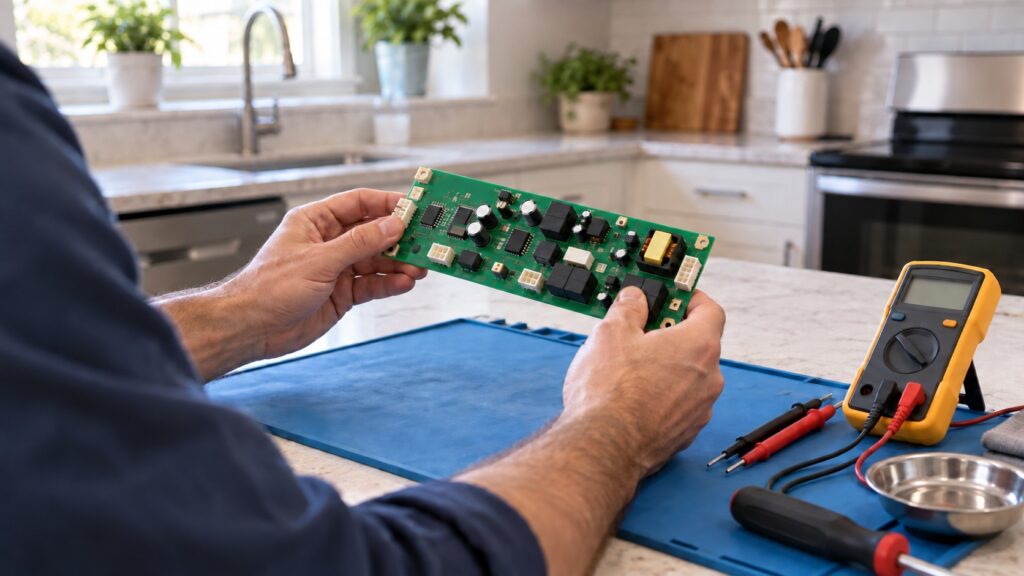
A Thermador control board is the part that turns a repair question into a conversation about the whole appliance. Everything else — an element, a valve, a hinge, a pump — is cheap enough that the answer is obvious. A board is the one component whose price approaches a meaningful fraction of the machine, which is why it deserves a page of its own rather than a line in a table.
First: it is often not the board
A large share of the appliances we are asked to price for a board are working fine. A dark or unresponsive panel is more often a lock engaged by accident, a demo mode left on from delivery, a supply problem, or a cooling fan that has failed and left the board protecting itself by shutting down.
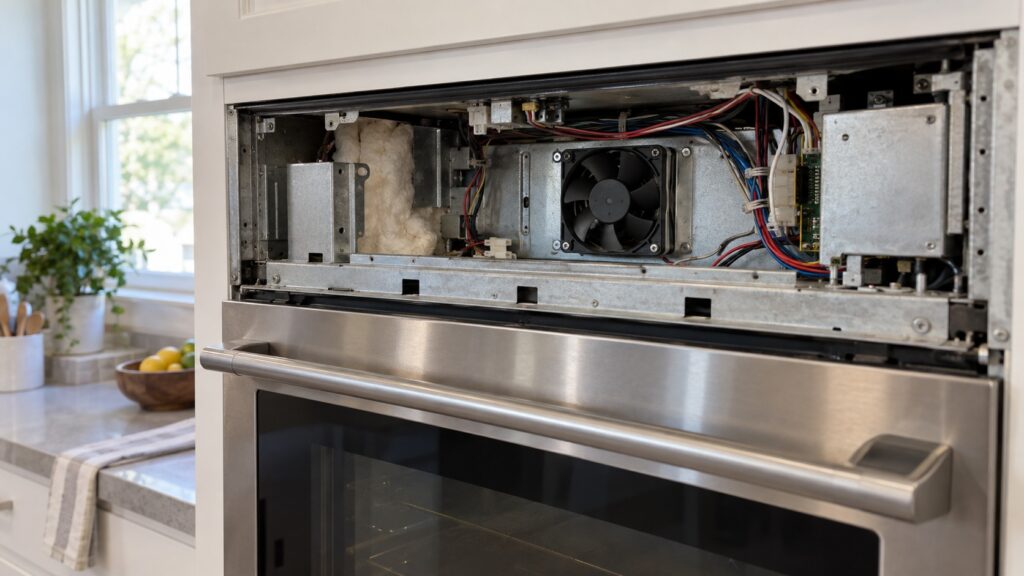
That last one matters. Electronics near an oven cavity are cooled deliberately, and a failed fan produces exactly the symptoms of a failing board — intermittent behavior, shutdowns after a period of use, a display that goes dark when things get hot. Replace the board without fixing the fan and you buy the same failure again. Our page on oven troubleshooting covers the checks.
Why a second failure changes the question
Boards do not usually wear out. They fail from heat, from moisture, or from a supply that is not clean — surges, a shared circuit with something heavy, a loose neutral. A single failure at ten years is ordinary. A second failure within a year or two is the appliance telling you about its environment.
The right response is to find the cause rather than to fit a third board. That means checking the cooling path, looking for moisture ingress at the seals, and asking what else is on the circuit. Fitting boards into an unchanged environment is the most expensive way to learn this.
Availability decides more than price
For an appliance under warranty or recently discontinued, a board is a stocked part. On an older model it may be made in small runs, remanufactured, or gone entirely — and the price follows scarcity rather than complexity. Two apparently identical decisions, on a nine-year-old and a fifteen-year-old appliance, can differ by a multiple because of nothing but supply.
That is why we establish availability during the diagnosis rather than after. It frequently decides the recommendation on its own, and it is not something anyone can quote from a description over the phone.
Where the appliance itself weighs in
- Under about eight years: a board is usually worth doing. Everything else in the appliance is untouched.
- Eight to twelve: it depends on the rest — cavity, seals, doors, the sealed system on refrigeration.
- Past twelve, freestanding: rarely the better value unless the part is inexpensive and available.
- 🔴 Built in at any age: repair is far more often right, because replacement is a joinery job. See column installation for what that involves.
Refrigeration is the exception worth knowing
On a refrigerator or a wine cabinet, the board is the cheap part of the appliance and the sealed system is the expensive one. A board on a unit whose compressor is sound is almost always worth doing, because the thing that actually determines the appliance’s remaining life is untouched by the fault.
The reverse also holds: a board failure on a unit that has separately started to struggle with temperature is not a board question at all. Our pages on refrigerator repair or replace and wine cooler repair or replace cover the split.
What a board actually does, and what it does not
People picture the board as the appliance’s brain and therefore as the thing responsible for everything. In practice it is a controller: it reads sensors, decides what should switch on, and drives relays that do the switching. The heating, the pumping and the motion happen elsewhere.
That distinction is useful diagnostically. A board can be perfectly healthy while the sensor feeding it lies — an oven that runs cool because a temperature probe has drifted is not a board fault, and a new board will run just as cool. Equally, a relay on the board that has welded closed produces an element that will not switch off, which looks alarming and is a board fault of a very specific kind.
Surges, and the cheapest protection there is
If boards have failed twice in a kitchen, the supply is the first thing to look at rather than the last. A kitchen shares circuits with motors that start hard — a disposer, a compressor, a well pump — and a modern kitchen packs a great deal of electronics into that environment. Whole-house surge protection is inexpensive relative to a single board on a built-in appliance, and it protects everything at once.
It is worth saying plainly that we do not sell or fit that; it is an electrician’s job. We raise it because we would rather not be called back to the same kitchen for the same part a third time.
What a diagnosis actually establishes
Four things, and none of them can be settled from a description. Is the fault really the board, or something upstream of it? Is the cooling and the supply around it healthy, so a new board would survive? Is the part available, and at what price? And is the rest of the appliance worth the spend — cavity, seals, doors, compressor.
An appliance that fails only the first question is a straightforward repair. One that fails the second is a repair plus a cause. One that fails the fourth is a replacement whatever the board costs.
Getting an honest number
We are an independent repair company, not a factory service arm and not a dealer, so we have nothing to sell you on the replacement side. Where a board is not worth fitting, we say so and explain why — and where something else is killing boards, we would rather find it than sell you another one. Pricing starts from a diagnostic visit and we confirm the estimate before any work begins.
Our services cover the electronics on every appliance in the range — oven, refrigerator, dishwasher and the rest — and you can schedule a visit online.