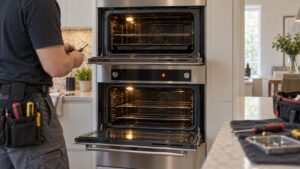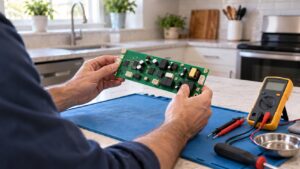
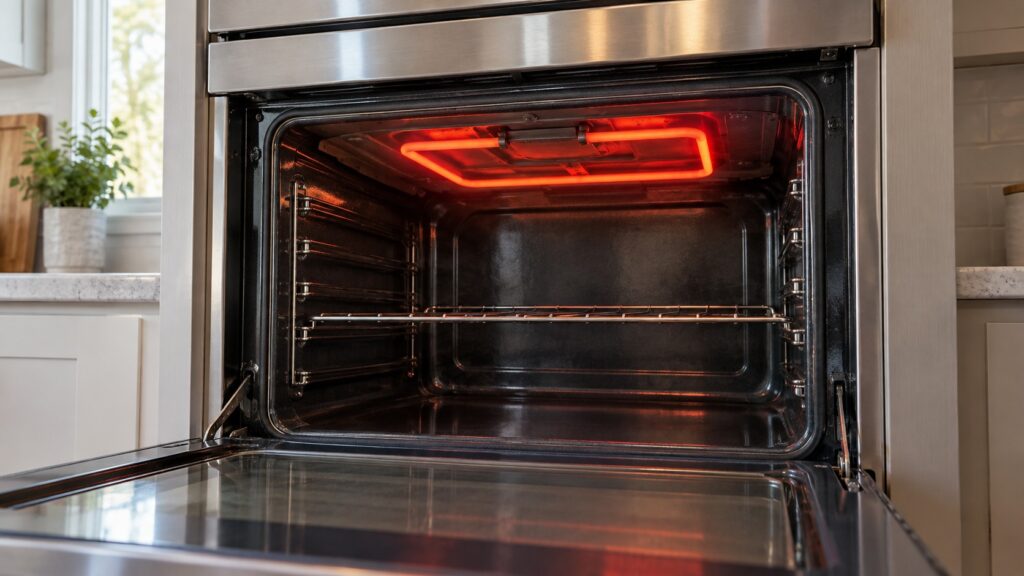
A Thermador oven E118 means the bake element relay is stuck closed and the board has detected heating that it never asked for. E218 is the same failure on the broil side. These two codes are the opposite of a complaint about a cold oven: the appliance is telling you it cannot stop the heat, which is why the board fires the code and cuts the cycle rather than waiting for you to notice.
Five codes on this site cover the heating elements and the relays that switch them, and they divide neatly into “will not stop” and “will not deliver”.
What is a relay, and how does one get stuck?
An oven element is a straightforward resistance heater that draws a great deal of current. The control board cannot switch that current directly, so it operates a relay: an electromagnet that physically pulls two contacts together, in the same way a light switch does, only a thousand times more often. Every cycle of bake at a set temperature is that relay closing and opening, hour after hour, year after year.
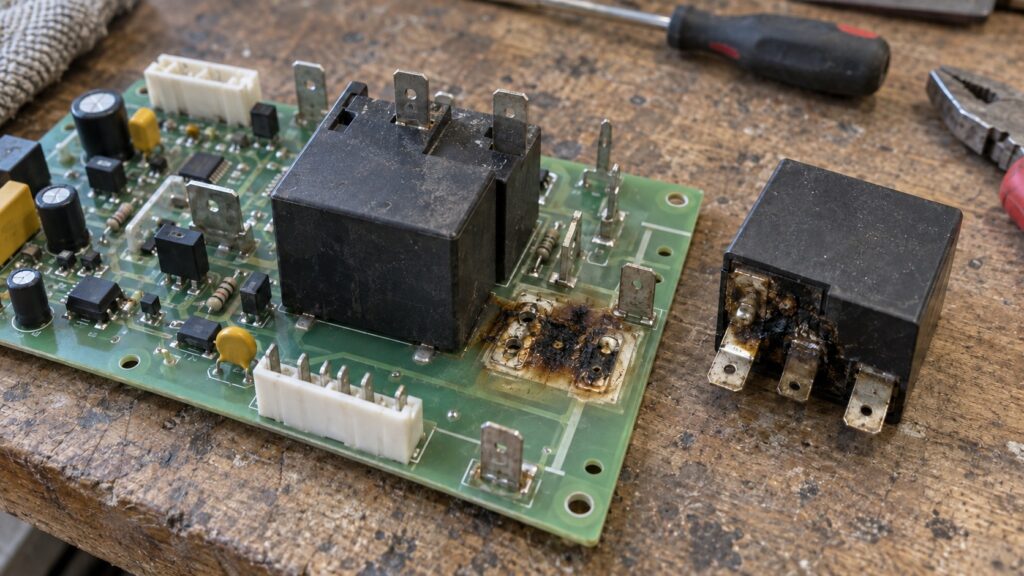
Contacts fail in two ways. They burn, which adds resistance and makes the element run at reduced output, and that is what E207 and E206 describe. Or they weld, which is when the tiny arc drawn at the moment of opening fuses the two surfaces together, so the relay never releases. The coil de-energizes, the board believes it has switched the element off, and the element keeps glowing. The board finds out because it is still watching the cavity temperature and it sees the number climbing when it should be falling.
Why is a Thermador oven E118 more urgent than an oven that will not heat?
Because the safety logic runs the other way. When an element fails open, the worst outcome is a ruined dinner. When a relay welds shut, the element is connected to line voltage whenever the appliance has power, regardless of what the display says and regardless of whether the door is open. A wall oven with a welded bake relay can sit in a kitchen that thinks it is switched off while the cavity quietly climbs toward the temperature at which the mechanical thermal cutout finally opens.
That is why this page starts with the breaker instead of with diagnosis. 🔴 If E118 or E218 is showing and you can feel heat from the cavity with the oven switched off at the panel, go to the electrical panel and turn off the oven circuit. Do not simply press cancel. The control panel is the thing that has lost authority over the heat, so its buttons are not a way of removing it.
What separates E118 from E207 on the same element?
They describe the same pair of contacts at two different stages of the same wear. Reduced output arrives first: the contacts have pitted, more of the supply is dropped across them than across the element, and the oven takes noticeably longer to preheat. People adapt to that for months without reporting it. The weld comes later, often during a broil cycle or a self-clean, which is when the current is highest and the arc is largest.
In practice, that makes E207 or E206 worth acting on as a warning rather than an inconvenience. An oven that has been preheating slowly for a season and then throws E118 has not suffered two faults. It suffered one, and the second code is the end of it.
Does E014 belong to the same story?
Only partly. E014 is a convection element open circuit — the ring heater that wraps around the fan at the back of the cavity has broken its own circuit, so nothing is delivered to it at all. That is an element failure rather than a relay failure, and it is a safe failure: an open circuit cannot overheat anything.
It is worth knowing about here for one reason. A Thermador oven with true convection uses that ring for most of its cooking, and an oven whose ring has failed will fall back on bake and broil, which loads exactly the relays this page is about far harder than normal. Our explainer on how true convection works covers what the ring and the fan are doing together.
Can I reset it and finish cooking tonight?
No, and this is the one recommendation on this page that is not negotiable. A relay that has welded once does not unweld. Cycling power sometimes clears the code because the board re-tests the circuit at startup and needs a heating cycle to catch the fault again, which makes it look as though the reset fixed something. It did not; it removed the warning while leaving the fault.
The right sequence is short. Turn the oven circuit off at the panel. Leave the door closed while the cavity cools, because a hot cavity vented into a room is its own hazard. Let the appliance cool completely before anyone opens it to look. Then book the visit, and leave the breaker off until the technician arrives.
When does this become a service call?
Immediately, for E118 and E218. The relays live on the power board behind the control panel or in the base of the cabinet, they are fed by a supply that is not switched off by the appliance’s own controls, and replacing a board that carries welded contacts is also the moment to find out why they welded: a marginal element drawing more current than it should, a poor terminal connection, or a cooling fan that stopped, which this site files as E009. E206 and E207 can wait for an appointment rather than an emergency, but they should not wait for a season.
We are an independent repair company, not a factory service arm. Pricing starts from a diagnostic visit and we confirm the estimate before any work begins. Thermador oven repair covers elements, relays, power boards and thermal cutouts, and you can schedule a visit online. If your symptom is the opposite one and there is no heat at all, start with a Thermador wall oven that will not heat, and for the full list see Thermador oven error codes.