A Thermador refrigerator E02 names one part in one place: the freezer compartment sensor. It is not a verdict on the compressor, the door or the food. It says that the thermistor watching the freezer side has given the board a reading it cannot accept, and until that reading comes back the board is running the cabinet on assumptions instead of measurements.
Four codes on this site belong to that same family of probes, and each one names a different compartment or a different job. The compartment is the whole point — confuse two of them and you replace a part in the wrong half of the appliance.
What does a Thermador refrigerator E02 actually measure?
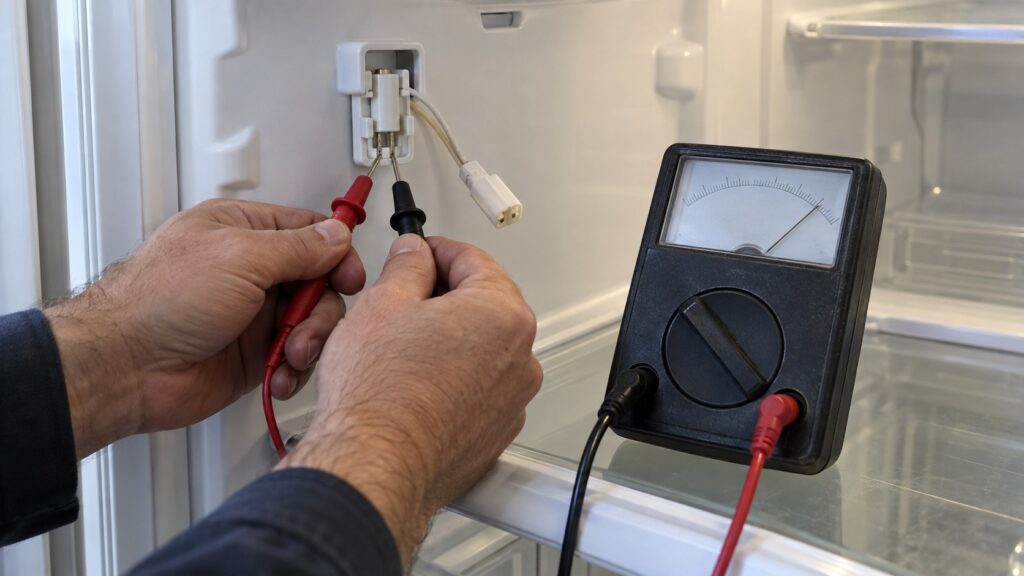
The sensor is a thermistor: a small bead whose electrical resistance changes predictably with temperature. The board sends a known current through it and reads the voltage that comes back, then converts that to a number of degrees. It also knows which readings are physically impossible. A thermistor with a broken wire reads as infinite resistance, which converts to an absurdly cold number. One that has shorted reads as almost nothing, which converts to an absurdly warm one. Either extreme raises the compartment code.
That is why the same code covers two opposite failures. The board is not saying the freezer is too warm or too cold. It is saying the probe is outside the range a working probe can produce, so every decision that depends on it has been suspended.
Which probe is which, and where does each one live?
There are at least two temperature probes on the frozen side of a Thermador column, and they do different jobs from different places.
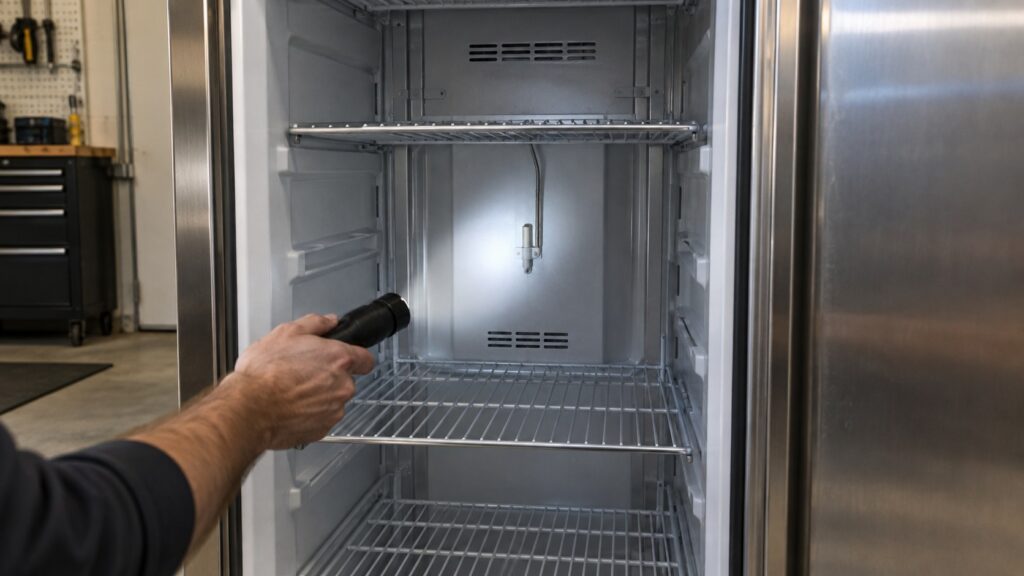
- The compartment sensor sits in the air stream, usually clipped behind the rear interior panel near the air outlet. It answers the question “how cold is the food space right now” and it is the one E02 names.
- The defrost sensor is clamped to the evaporator coil itself, behind the same panel but further in. Its job is to tell the board when the coil has warmed enough to have shed its frost, so the defrost heater can be switched off. That is the probe E13 is about.
The distinction matters because the symptoms diverge. A failed compartment sensor gives you a cabinet running on a default schedule — often too cold, sometimes too warm, and usually noisier than normal because the compressor has no reason to slow down. A defrost sensor that has drifted gives you a coil that is slowly icing over, and the first thing you notice is not temperature but airflow.
Why is the display showing a normal temperature?
Because the display shows the setpoint, not a measurement. On most Thermador columns the number on the panel is what you asked for, and it will keep showing that number while the board has no idea whether it is being achieved. This is the single most common reason a refrigerator E02 gets ignored for a week.
Check the real temperature instead: a glass of water with a thermometer in it on a middle shelf for four hours on the fresh food side, and a thermometer set between packages on the frozen side. Two honest readings turn a vague code into a clear picture of whether the cabinet is still doing its job while the board flies blind.
How do I tell a sensor fault from a defrost fault?
Look at the back wall of the freezer, and look at the airflow. These are the signs that separate the two.
- Frost on the rear interior panel in a growing patch, with ice forming around the air vents, points at the defrost side: E13 or E05.
- Ice cream that has gone soft while the ice cubes look fine, or the reverse, points at a compartment reading the board cannot trust.
- A compressor that never seems to stop, with correct or over-cold temperatures, is typical of a compartment sensor reading colder than reality.
- Water on the floor of the freezer or running down the back belongs to the drain, not to either sensor, and is covered in Thermador freezer troubleshooting.
One more thing separates them. A defrost problem builds over weeks and gets worse after every door opening in humid weather. A compartment sensor fault usually appears in a single day, because a wire either broke or it did not.
What is safe to do before a technician arrives?
Cut power at the breaker for five minutes and restore it; a code that clears and stays away for a week was a transient, and one that returns the same evening is a real fault. Empty the freezer of anything you cannot afford to lose and move it to another appliance, because a cabinet running without a trusted probe is not a cabinet you should trust with food for long. Take a photograph of the code on the display, including any two-part code such as E01-2, so the exact form survives the reset.
🔴 Do not pull the rear interior panel of a column freezer to reach the probe yourself. The evaporator coil and the defrost heater sit directly behind it, the panel is usually frozen in place, and forcing it is how an aluminum fin line and a refrigerant tube get punctured. A sealed system leak turns a sensor job into a much larger one.
When is this a service call?
A compartment sensor is a measurable part — its resistance at a known temperature either matches the specification or it does not — but reaching it means removing an interior panel with a heater and a coil behind it, on a column that is fixed into cabinetry. E13 and E05 add a defrost heater and its circuit to the same access. All of that is service work rather than kitchen work.
We are an independent repair company, not a factory service arm. Pricing starts from a diagnostic visit and we confirm the estimate before any work begins. Thermador refrigerator repair covers sensors, defrost systems and control boards, and you can schedule a visit online. For the wider code list on this appliance, see Thermador refrigerator error codes; if the compressor rather than a probe is being named, our guide to E11 and E20 covers that side.