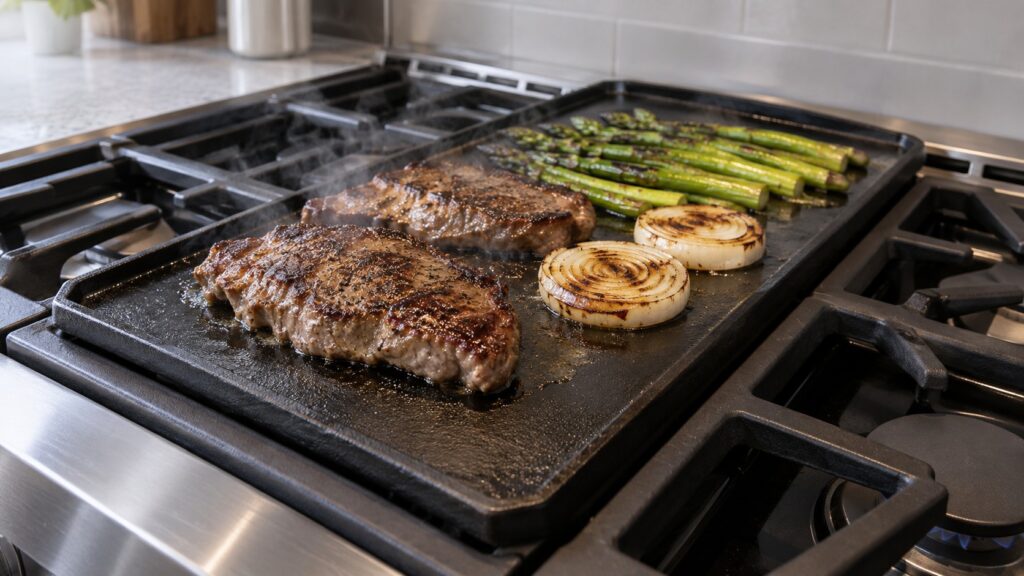
Thermador range griddle care comes down to one habit: curing the surface before the first real use and reheating that seasoning regularly afterward, rather than treating the griddle insert like a nonstick pan that needs nothing beyond a wipe. A center griddle insert is bare or lightly finished metal on most Thermador ranges, and without a seasoned layer built up over its early uses, food sticks, the surface spots with rust in humid kitchens, and cleanup gets harder every time rather than easier.
Why does a Thermador range griddle need curing before you cook on it?
A new griddle insert arrives with a bare or minimally treated metal surface, and that surface has none of the seasoning that keeps food from sticking and keeps the metal from reacting with moisture in the air. Curing builds that seasoning layer deliberately: a thin coat of a high-smoke-point oil, heated gradually until it polymerizes into a smooth, slightly dark finish bonded to the metal. Skip this step and the first several uses will stick more than they should, and the surface is more exposed to spotting or light rust than it would be once seasoned.
Curing is not a one-time event either — the seasoning layer thins with every cleaning and every cook, and rebuilding it with a light oil pass after cleaning is what keeps the griddle performing the way it did when it was new rather than gradually reverting to bare metal.
What is the right way to clean a griddle insert after cooking?
Scrape the surface while it is still warm, not after it has gone fully cold — warm residue lifts with much less effort than the same residue once it has hardened. A wooden or nylon scraper does this job without cutting into the seasoning layer the way a metal spatula or a steel scouring pad will. Wipe the surface with a paper towel or cloth, and for anything that does not lift with scraping alone, a small amount of water on the still-warm surface followed by another wipe usually finishes the job without needing soap, which can strip built-up seasoning if used aggressively or too often.
Avoid dish soap as a routine cleaner for a seasoned griddle the same way you would avoid it on a well-seasoned cast iron pan — occasional use is not going to ruin the seasoning outright, but making it the default cleaning method will thin the layer faster than normal use alone.
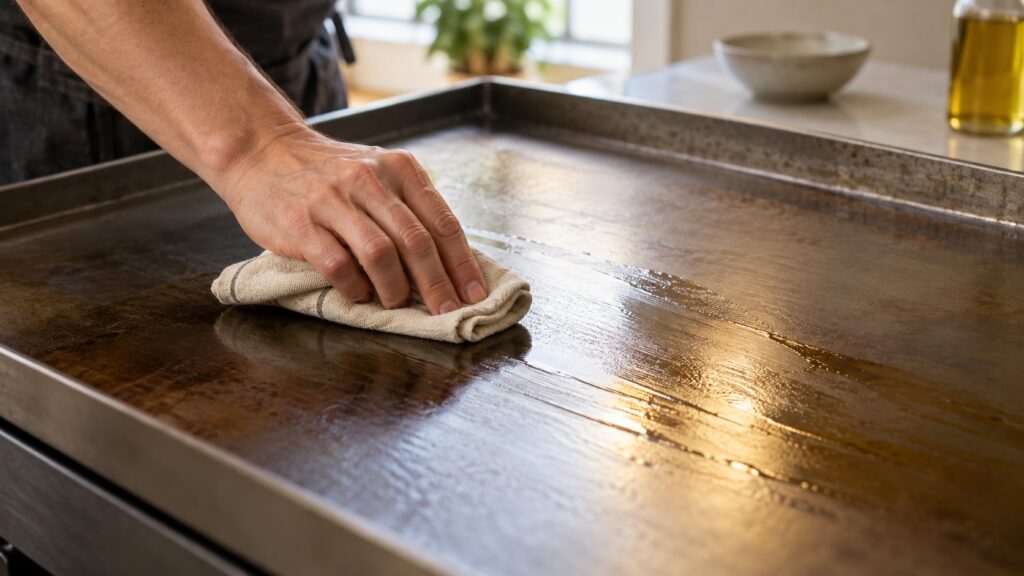
Why does the griddle need re-oiling every time you clean it?
Every cleaning pass, even a gentle one, removes a small amount of the seasoning layer along with the food residue it is lifting. A thin wipe of oil applied to the still-warm surface after cleaning replaces what the cleaning took off, which is what keeps the seasoning building up over time instead of slowly wearing away. Use a folded paper towel to spread a genuinely thin film — enough to leave a light sheen, not a pool of standing oil, which can turn gummy rather than bonding cleanly on the next use.
This is the single habit that separates a griddle that performs better every year from one that seems to need more oil and more scraping every time you use it. Skipping the re-oiling step after cleaning, even occasionally, is usually why a griddle that used to release food easily starts sticking again.
What causes a griddle insert to warp?
Warping is almost always a thermal shock problem rather than a sign of a defective part. Preheating a griddle too aggressively from cold, or splashing cold water onto a surface that is still hot from cooking, forces one section of the metal to expand or contract faster than the section next to it, and repeated shocks like that can leave a griddle with a bowed or uneven surface over time. Preheat gradually rather than jumping straight to a high setting, and let the surface cool most of the way down before it meets water for cleaning.
A griddle that has already developed a slight warp is not necessarily unusable, but an uneven surface does affect how evenly food cooks across it, and a warp that is pronounced enough to rock the insert or leave a visible gap against the cooktop is worth having looked at rather than worked around indefinitely.
How do you store a griddle insert between uses?
Make sure the surface is fully dry before putting the insert away — moisture trapped against bare or lightly seasoned metal is exactly the condition that starts surface rust, especially in a humid kitchen or if the insert is stored in a drawer with limited airflow. A light film of oil left on the surface after the final cleaning of a session, the same one applied after every cleaning, does double duty here: it finishes rebuilding the seasoning and it protects the surface from moisture while the griddle sits unused.
If a griddle insert does develop light surface rust after being stored damp or unused for an extended period, a fine steel wool pass focused only on the rusted spot, followed by a full re-cure of the surface, typically brings it back — but that is a recovery step, not a routine one, and keeping the surface dry and oiled before storage is what avoids needing it.
When does a griddle problem need more than care and re-seasoning?
Sticking, minor surface rust, and dullness from a thinned seasoning layer are all maintenance issues that respond to cleaning and re-oiling. A griddle that heats unevenly with the burner otherwise working normally, a warp pronounced enough to rock on the cooktop, or a surface with pitting that goes beneath the seasoning layer rather than sitting on top of it point at something beyond routine care. Our Thermador range maintenance guide covers the rest of the range’s upkeep alongside the griddle insert, and our StarSpeed burner guide covers the burner beneath the griddle insert when it is not set up for griddle cooking.
We are an independent repair company, not a factory service arm. Pricing starts from a diagnostic visit and we confirm the estimate before any work begins. Thermador range repair covers burner and surface issues beyond what re-seasoning can fix, and you can schedule a visit online.