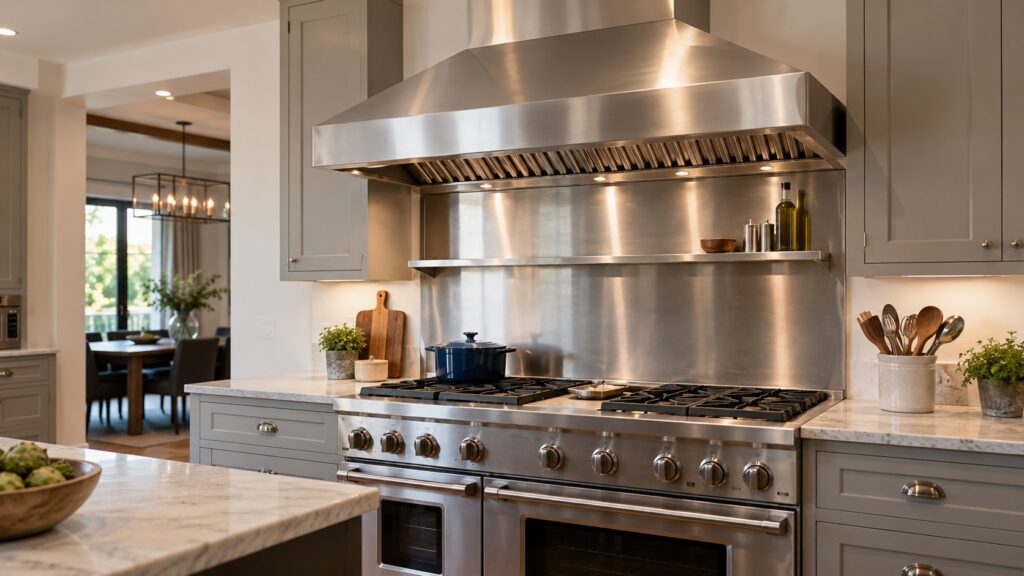
Thermador make-up air is the fresh air you deliberately bring into the house to replace what a powerful vent hood throws outside. A hood that exhausts hundreds of cubic feet of air every minute creates negative pressure in a tight modern home, and without a planned supply that air is pulled from wherever it can find it: fireplace chimneys, water heater flues, door gaps and bathroom vents. Many building codes require a make-up air system once a hood passes a certain airflow, so plan it before the hood goes in.
What is make-up air for a Thermador vent hood?
Air that leaves a house through a hood has to be replaced. In older, leakier houses that happened quietly through gaps around windows and doors. Modern houses are built much tighter, so the replacement air has few easy paths. Make-up air is the planned path: a duct from outdoors that delivers fresh air into the home, usually timed to switch on when the hood runs. The goal is a balanced house, where the hood can move air out without fighting the building.
Thermador hoods, particularly the professional wall and island models, are designed to move a lot of air, which is why the topic comes up so often with them. Our guide to how a Thermador vent hood works explains the fan, the capture area and the ductwork that make that airflow possible.
What happens without make-up air?
The symptoms are easy to spot once you know them. The hood seems weaker than its rating, because the blower is working against a pressure difference and cannot move its full volume. Doors can be hard to open or slam shut. You may hear whistling at gaps and window frames. The most serious concern is backdrafting: the hood can pull exhaust gases down the flue of a gas water heater, furnace or fireplace and into the living space, which is a combustion safety problem, not just a comfort one.
Other signs include odors from drains, a cooktop flame that flickers when the hood starts and a hood that is noisy because the fan is straining. If any of these appear after a new hood installation, make-up air is the first thing to check. Our guide on Thermador vent hood noise explains how airflow restriction produces fan noise, and why a supply path can fix it.
When is make-up air required?
Codes differ, but a common trigger is an exhaust rating above roughly 400 cubic feet per minute, which many professional-style hoods exceed. Some jurisdictions set different thresholds or add conditions based on the type of fuel burned by the cooktop. The only reliable source is your local building department. Ask the code official which edition they enforce, what threshold applies to your hood and what kind of system they accept.
Even where not required, make-up air is smart for a tight house with a powerful hood or any home with combustion appliances. Our Thermador vent hood CFM guide explains how to read the airflow ratings so you know where your hood falls. Share the rating with your contractor before the rough-in, because it determines the size of the system.
What types of make-up air systems are there?
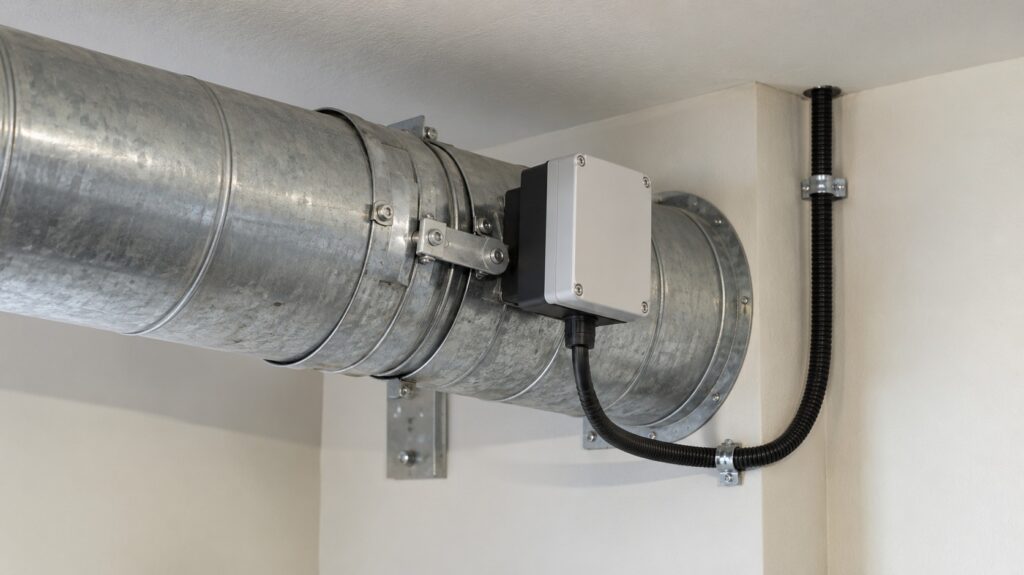
The simplest system is a passive duct from outdoors with a motorized damper. When the hood turns on, the damper opens and the negative pressure draws air in through the duct. It is cheap and quiet, but cold air arrives untreated, which can be uncomfortable in cold climates. A more refined system uses a duct with an in-line heater that warms incoming air to a modest temperature, or ties into the home’s heating and cooling system so the air is tempered before it reaches the living area.
Another approach is a powered supply fan interlocked with the hood, which actively pushes air in to match the exhaust. It is more complex and more costly but gives the best control in demanding installations. The choice depends on climate, house size and hood capacity, and a mechanical contractor can size and design it. Do not guess; an undersized duct is no better than none, and an oversized one wastes money. Ask the contractor for the calculation they used, and keep it with your permit papers, since the next owner or an inspector may ask how the system was sized.
How does make-up air fit into the installation plan?
Plan it at the same time as the hood’s duct run, while walls and ceilings are open. The make-up air duct needs a clear path from an exterior wall or the attic to a location in or near the kitchen, away from the hood so that fresh air is not simply pulled straight into the exhaust. The damper needs power and a control connection to the hood. Leaving this until after the cabinets are in turns a simple job into an expensive one.
Coordinate with the person who installs the hood. Our Thermador vent hood installation guide covers the mounting height, duct size and run length, and the Thermador range installation guide covers clearances under the hood. Good planning here also helps efficiency, as described in our Thermador vent hood efficiency tips.