These Thermador induction terms explain the words you meet on a cooktop page, in the manual and on the display. Induction heats the pan, not the glass, so most of the vocabulary is about the pan, the coils underneath and the electronics that drive them. This glossary uses plain words, ties each term to what our site says about Thermador cooktops such as the CIT305YM, CIT365KM and the Freedom CIT367TMS, and sends you to your owner’s manual for how a term works on your exact model.
What does induction mean on a Thermador cooktop?
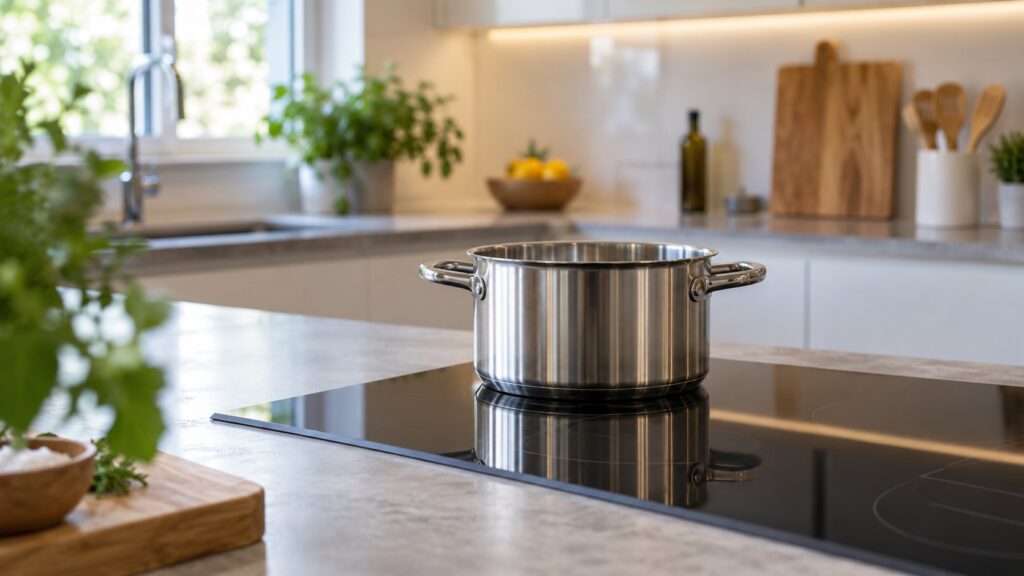
Induction is a way of heating that works through a magnetic field. Under the glass is a coil of wire, and when the cooktop is on, the coil creates a field that makes heat in a pan placed on it. The glass itself is not the heat source, which is why a pan heats fast and the glass stays cooler around it. Our explainer on how Thermador induction works goes through the idea in more detail.
Because the glass gets warm only from the pan, you may still feel heat on the surface after you lift a pan. That is why induction cooktops have a residual heat indicator, covered below. Which pans work, how the cooktop senses them and what the controls do on your model are in your manual.
What is ferromagnetic cookware?
Ferromagnetic means a metal that a magnet sticks to. Induction only heats cookware with that property, such as cast iron, enameled cast iron and many stainless steel pans. Our induction guides give the simple test: if a magnet sticks firmly to the bottom of the pan, it works, and pans that a magnet does not hold, such as aluminum, copper or glass, will not heat. Our induction cookware tips explain which pans to use.
A pan with a warped or very rough base can heat unevenly. Keep the bottom flat and clean, and check your manual for what it says about cookware.
What are the coil, the inverter and the sensor?
The coil is the wire under the glass that makes the magnetic field. The inverter is the electronics that convert the power from the house into the form the coil needs, and our cooktop glossary says each zone has its own inverter circuit. On Freedom models, a sensor array under the glass detects where a pan is. These are the parts behind several codes on our cooktop code pages, such as E8 for an inverter board overtemperature and E7 for a cooling fan failure with overheating risk.
You do not touch any of these parts. They are under the glass and connected to household power, and a technician is the person who tests or replaces them. If a code appears, write it down exactly and look it up in our Thermador induction error codes guide.
What are a zone and a bridge?
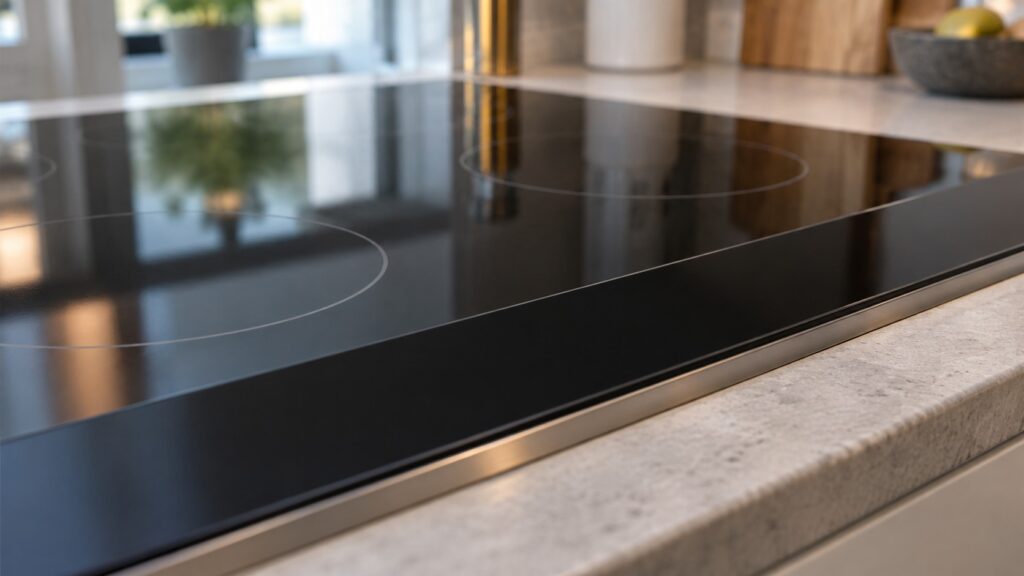
A zone is a cooking area with its own coil and its own control. A bridge zone, which our glossary describes as a feature connecting two adjacent induction zones into one large zone, lets you use a griddle or an oversized pan across both. The CIT365KM page says it has five zones including a bridge element, and the CIT305YM page lists four zones.
When two zones are joined, they act as one: you set one level and both heat together. If the bridge does not work, our code pages describe E9 as a bridge zone communication error. Your manual explains how to turn the bridge on and what size of pan it is meant for.
What does Freedom mean on a Thermador cooktop?
Freedom is the Thermador name for full-surface induction. Our model page for the CIT367TMS describes a full-surface induction cooktop with no fixed zones and integrated downdraft ventilation. In our Freedom guide, a grid of coils under the glass and a sensor matrix detect where you place a pan, and only the coils under it are active. That is why you can slide a pan across the surface and the heat follows it.
Because there are no printed circles, size and placement matter: a pan that is too small or off the sensing area may not be detected. Our Thermador Freedom induction guide goes into the details and is worth reading if you own one.
What is a residual heat indicator?
It is a display that shows which areas of the glass are still hot after cooking. It matters on induction too, because heat from a pan can soak into the glass. Treat any area where the indicator is lit as hot, even if the zone is off. Our code pages describe E10 as a residual heat indicator problem. If the indicator does not light or does not go out when it should, do not rely on touching the glass to check; have it looked at.
The same safety logic applies to a radiant electric cooktop like the CET305YB, which our page lists with residual heat indicators. Your manual describes how the indicator behaves on your model.
Two more terms come up on the same pages. Touch controls are capacitive controls on the glass, with no mechanical buttons. They respond to the touch of a finger and can be thrown off by water or grease on the control area, so wipe the glass dry before using them. Downdraft is a retractable ventilation unit that rises from the cooktop, as on the CIT367TMS, so that no overhead hood is needed. Our cooktop cleaning tips explain how to clean around controls without letting liquid creep into the gaps.
When does a term turn into a repair?
When a term appears on the display as a code, stays lit when it should not or stops working when it should. A code, a zone that will not heat with a correct pan, a bridge that will not join or a control that does not respond all point to a technician. If water gets under the glass or you see sparks or smell burning, switch off the breaker for the cooktop at the panel while standing on a dry floor. We are an independent repair company, not the manufacturer. Our Thermador cooktop repair page explains how a visit works, and you can book a visit online.