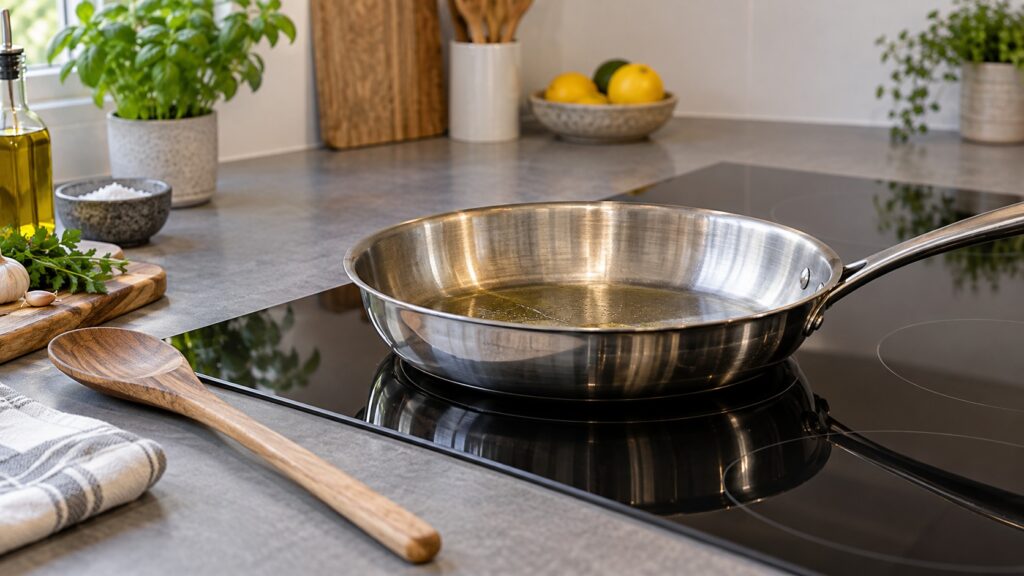
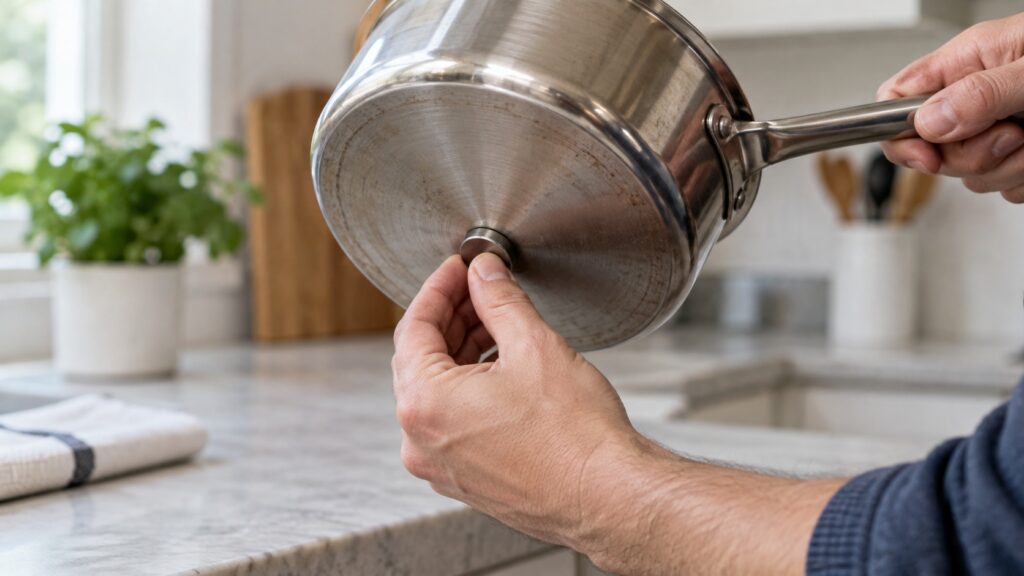
Thermador induction cookware has to meet two tests: the base must be magnetic, and it must sit flat on the glass and cover most of the cooking zone. Hold a magnet to the bottom of the pan. If it sticks firmly, the pan will heat on a Thermador induction cooktop. If it does not, the cooktop will not detect it, and no setting will fix that. Most complaints about a cooktop that will not heat, buzzes or heats unevenly come down to the pan, not the cooktop.
How does induction decide whether a pan works?
An induction cooktop does not heat the glass. Under each cooking zone sits a coil that creates a rapidly changing magnetic field, and when a pan with a magnetic base sits on that zone, the field produces electrical currents in the metal. The currents heat the pan directly. This is why induction is fast and precise, and why the glass stays much cooler than the pan. It also explains the cookware rule: no magnetic metal in the base, no heating.
The cooktop checks for a pan before it starts. If it detects a suitable base, the zone turns on. If it detects nothing, or something too small or non-magnetic, it stays off or flashes a warning. If you want to understand the technology behind this, our guide to how Thermador induction cooking works explains the coils and the sensors in simple terms.
Which pots and pans work on a Thermador induction cooktop?
Cast iron works very well, as does enameled cast iron, because the iron is magnetic and holds heat. Many stainless steel pans work too, but only if the steel type is magnetic, so do the magnet test instead of assuming. Most good clad pans with a stainless exterior are induction ready, and many manufacturers mark the base with a coil symbol. Carbon steel pans, including woks with a flat base, also work.
Pure aluminum, pure copper, glass and most ceramic cookware do not work, since they are not magnetic. Some of these pieces are sold with a magnetic plate bonded to the bottom, which makes them induction compatible, and the base is often marked. Before you buy new cookware, look for the induction symbol on the packaging, and keep a small magnet in the kitchen drawer for older pieces. The test takes seconds.
If you are building a new set, you do not have to replace everything at once. Start with the pans you use most, usually a large skillet, a medium saucepan and a stockpot, and test the rest of your collection with the magnet before you give anything away. Many households find that half of their existing cookware already works, and that one or two good induction-ready pieces fill the gaps. Heavy, flat-bottomed pans also make better use of the precise control that induction gives you, because they hold and spread the heat evenly.
Does pan size matter?
Yes. The coil creates its field across a defined area, and the pan needs to cover enough of that area for the cooktop to detect and heat it. A base much smaller than the zone may not register, or may heat only the center. A very large pan overhanging the zone heats well only where it lies over the coil, so the edges stay cooler. Aim for a base that covers most of the zone, and use the smaller zones for small saucepans.
Flexible or bridged zones on larger models can combine areas for a griddle or a long pan, and the rules about covering the zone still apply. Our Thermador Freedom induction guide explains how the Freedom layout works for large and oddly shaped pans.
Why does my induction cookware buzz or hum?
A low hum or buzz is common on induction, and it comes from the cookware as much as the cooktop. The magnetic field makes layers of metal in a pan vibrate slightly, especially at high power and in pans made of several bonded layers. The sound often fades when you reduce the heat. Loose lids, thin pans and warped bases buzz more than heavy, flat ones.
A buzz is usually harmless. Try a lower power level, move the pan to another zone, or try a different pan. If a particular pan buzzes loudly, it may be a poor fit for induction. If every pan is noisy even at low power, or the cooktop makes a clicking or crackling sound that is out of character, our Thermador cooktop troubleshooting guide covers the next checks.
How do you protect the glass and keep cookware working?
Lift pans instead of sliding them, because sliding a rough cast iron base across the glass can leave scratches. Check the bottom of each pan for burrs or stuck-on food, which scratch the surface. Keep the glass clean, because burned-on spills can hold the pan slightly off the surface and affect heating. Wipe spills once the glass has cooled, and see our Thermador cooktop cleaning tips for the right products.
Do not place empty pans on a hot zone or leave a pan heating dry. Induction heats quickly, and an empty pan can overheat in seconds, damaging both the pan and the glass. Avoid placing metal utensils or foil on the cooking surface, as they can heat up. If you cook with oil at high heat, stay near the cooktop and keep the pan under control.